
The Alchemy of Heartbreak and Hope: A Spiritual Practice for Our Time

Keynote talk given by Jeremy Lent to The Whidbey Institute annual gala, October 2020.

“When we truly open our hearts to each other, there is no burden too heavy for us to carry together, there is no pain too deep for us to hold in each other’s arms. And it’s in that place—of feeling the Earth’s injuries, and feeling it with each other—that the alchemy emerges. It’s in the cauldron of sharing our grief with our community, of gazing at it together and not looking away, that the heartbreak turns to hope.”


It’s so wonderful to hear Tyson (Yunkaporta, author of Sand Talk) talk about how we need to listen to natural law. It’s what our modern civilization needs to hear. I’m sure most of us share with Tyson the sense that our society has trampled on natural law; that we live in a world where indigenous knowledge, and the things that are most valuable to life are ignored, while those that are most destructive are valued the highest.

Speaking here from Northern California, we’ve been sharing with Tyson and his fellow Australians the grim experience of what happens when natural law is violated. It was less than a year ago that we were all horrified by the pictures coming out of Australia of apocalyptic wildfires—fires that were estimated to have killed a billion animals in the Outback. And it was just a month ago that those of us living here in the Bay Area woke up to our own vision of doomsday—a day without daylight, as the smoke from millions of acres of wildfires raging across the northwest settled over our skies, allowing nothing but a blood red glow to penetrate.

But of course, those of you here today don’t need these harbingers of doom to know that something is terribly wrong with where our world is headed. We all know, in spite of everything our media does to deflect our attention, that our global society is careening at an increasingly rapid rate toward the precipice. We know that people are suffering out there as a result of callous economic policies, that the onset of coronavirus has made that suffering even greater—and that increasing climate breakdown will only lead to deepening misery, with massive droughts and famines, and hundreds of millions of climate refugees forced to abandon their homes in desperation with no-one willing to receive them.

We know that the natural world is reeling from a relentless rampage of human exploitation. That the Amazon rainforest—the lungs of the Earth—is disappearing at the rate of more than an acre a second. The World Wildlife Fund recently reported that since 1970, animal populations worldwide have declined by 68%—and in Latin America, by a mind-boggling 94%. The richness of nature is getting virtually wiped out in our lifetime.

It’s impossible to face these realities head on without feeling your heart break. Speaking for myself, when I’ve contemplated this humanmade enormity, I’ve sometimes felt swallowed up into an infinite abyss of darkness. Is it any wonder that people turn away from facing these facts, that they see one of those frightening headlines warning about climate breakdown and they click anywhere but there, read their Facebook feed, check out the latest tweet, watch the report on this week’s political scandal? We live in a world designed to keep us numb—a culture spiked with incessant doses of spiritual anesthesia conditioning us to deaden our feelings, and adapt to the daily grind.

But it’s that very heartbreak that can free us from the consensus trance that our society imposes on us. The realization of our true nature, and the agony of life’s destruction at the hands of this civilization, are two sides of the same coin. That’s because, when we awaken to our true nature as humans on this beautiful but fragile Earth, when we feel the life within ourselves that we share with all other beings, then we recognize our common identity with all of life. We live into what Thích Nhât Hanh calls our interbeing.

And as we open awareness to our interbeing, our ecological self, we experience ourselves, in the words of Albert Schweitzer, as “life that wills to live in the midst of life that wills to live.” And then, we realize the deep purpose of our existence on Earth is to tend its living system, to tend Gaia, and participate fully in its ancient, sacred unfolding of vibrant beauty. And when we see the relentless way that beauty is being eviscerated, Gaia’s pain becomes our pain. It’s not just happening in the forests and the deep oceans, it’s happening to us—to our own ecological interbeing. As Thích Nhât Hanh puts it, we “hear within us the sounds of the Earth crying.”

But that pain of the Earth crying . . . it’s too much for any one of us to hold by ourselves. And that’s where we need to turn to another equally important dimension of our interbeing: our shared community of caring. When we truly open our hearts to each other, there is no burden too heavy for us to carry together, there is no pain too deep for us to hold in each other’s arms.

And it’s in that place—of feeling the Earth’s injuries, and feeling it with each other—that the alchemy emerges. It’s in the cauldron of sharing our grief with our community, of gazing at it together and not looking away, that the heartbreak turns to hope.

But let’s be clear what I’m talking about when I use the word “hope.” I’m not talking about the odds we might give for the likelihood of a positive outcome. Hope is not optimism. It’s something completely different. Rather than a prognostication, it’s an attitude of active engagement in co-creating our future. In the words of Václav Havel it’s a “deep orientation of the human soul that can be held at the darkest times . . . an ability to work for something because it is good, not just because it stands a chance to succeed.”

“To work for something, just because it is good.” This kind of hope is itself a transformation: from a noun to a verb. The alchemy takes place when we feel the heartbreak, with our community, so thoroughly within ourselves that there is nothing else to do but get engaged. Just like, when you feel physical pain in your body, you are moved reflexively to do something about it, so when we feel the Earth’s pain throughout our being, we are naturally moved to action. Because true knowledge isn’t just an intellectual idea, it’s something that infuses our entire body. One of the great sages of Chinese thought, Wang Yangming, made this crystal clear when he said: “There have never been people who know but do not act. Those who are supposed to know but do not act simply do not yet know.”

And something I’m sure about is that everyone here today is drawn to the Whidbey Institute because you do know, and you are impelled to action. And there is so much we can be doing to participate in the Great Transformation our global society needs to move from its current self-destructive path to one that offers a brighter future. It’s not just a matter of fixing a few things. Our civilization needs to be transformed at the deepest levels. We need to move from our current wealth-based society that’s been built on exploitation, on seeing people and the natural world as mere resources, to one that, like Tyson said, is based on natural law—an ecological civilization. What’s required is a metamorphosis of  virtually every aspect of the human experience, including our values, our goals, and our daily norms.

Sounds like a tall order? I’m sure, when a dozen or so Quakers gathered in London in 1785 to create a movement to abolish slavery, people told them “Impossible! Our economy is based on it.” Within half a century, slavery was abolished throughout the British Empire. When Emmeline Pankhurst founded the National Union for Women’s Suffrage in 1897, it took ten years of struggle to muster a few thousand courageous women to join her on a march in London—but within a couple of decades, women were gaining the right to vote across the world. There is a crucial lesson to learn from these, and other, examples—like all self-organized, adaptive systems, society changes in nonlinear and unexpected ways. And oftentimes, the change is catalyzed by just a few, visionary souls working together against the odds—because they know what they’re doing is right.

We may not know what the future holds for humanity, but we do know that every day of our lives, we can choose to live into the future we wish for ourselves and for the rest of life. And just like the mycorrhizal underground network in the forest that trees use to support each other, when we connect with each other, we’re part of a powerful network that’s accomplishing something very different than what we may read about in the daily headlines.

Keep in mind that, as the current system begins to unravel on account of its internal failings, the strands that kept the old system tightly interconnected also get loosened. The old story is losing its hold on the collective consciousness of humanity. As waves of young people come of age, they are increasingly rejecting what their parents’ generation told them. They are looking about for a new way to make sense of the current unraveling, for a story that offers them a future they can believe in.

That is the great work that I believe the Whidbey Institute, and many of you present here today, are engaged in. Creating that new story, and living into it, is the alchemy of heartbreak and hope that we are generating together. And I, for one, am excited to be a part of this epic moment when we, together, can participate in co-creating the possibility of humanity’s flourishing future on a regenerated Earth.


Jeremy Lent is author of The Patterning Instinct: A Cultural History of Humanity’s Search for Meaning, which investigates how different cultures have made sense of the universe and how their underlying values have changed the course of history. His upcoming book, The Web of Meaning: Integrating Science and Traditional Wisdom to Find Our Place in the Universe, will be published in Spring 2021 (New Society Publishers: US/Canada | Profile Books: UK/Commonwealth). For more information visit jeremylent.com.
The Five Real Conspiracies You Need to Know About

While millions of people are spellbound by false conspiracy theories, the real conspiracies that are wrecking our world go about their business unheeded. Here are five genuine threats that everyone should know about—and take action on.

The world is awash in a deluge of dangerous conspiracy theories. Most notoriously, the bizarre QAnon fantasy postulates that a global child sex-trafficking ring is being run by liberal, Satan-worshiping pedophiles whose plot will be uncovered by President Donald Trump on a “day of reckoning” involving mass arrests. This surreal mass delusion is not the only one infecting millions of people around the world. Earlier this year, the Plandemic conspiracy video went viral on social media, instilling disinformation into millions of minds about Covid-19, falsely alleging that it was a hoax perpetrated by big business for the sake of profiteering by selling mass vaccinations.

One of the most harmful results of these bogus conspiracy theories is that they help deflect people’s attention from the real conspiracies that are systematically damaging billions of people around the world, destroying the living Earth, and—if left unchecked—may drive our entire civilization to collapse. These are the conspiracies everyone needs to know about. Unlike the QAnon and Plandemic nonsense, they are real. The facts about them are in the open, yet these lethal conspiracies hide in plain sight, flagrantly going about their destructive activities while millions of people have their attention diverted toward pernicious fictions.

Let’s take a look at five of the most damaging conspiracies out there. As you consider them, I invite you to ponder how it is that, while our mass media focuses attention on imaginary conspiracies, the real ones that threaten every one of us are barely even discussed.

1. Conspiracy to turn the world into a giant marketplace for the benefit of the wealthy elite

Back in 1947, as the world was rebuilding from the destruction of the Second World War, a few dozen free-market ideologues met in a luxury Swiss resort to form the Mont Pelerin Society—an organization devoted to spreading the ideology of neoliberalism throughout the world. Their ideas—that the free market should dominate virtually all aspects of society, that regulations should be dismantled, and that individual liberty should eclipse all other considerations of fairness, equity, or community welfare—were considered fanatical at the time. Over three decades, though, financed by wealthy donors, they assiduously expanded their plot for global domination, establishing networks of academics, businessmen, economists, journalists, and politicians, in global centers of power.

When the stagflation crisis of the 1970s threw classic Keynesian economics into disrepute, their moment of opportunity arrived. By 1985, with free market disciples Ronald Reagan and Margaret Thatcher entrenched in power, they initiated a campaign to systematically transform virtually all aspects of life into an unrestrained marketplace, where everything could be bought and sold to the highest bidder, subject to no moral scruple. They crippled trade unions, tore up social safety nets, reduced tax rates for the wealthy, eliminated regulations, and instituted a massive transfer of wealth from society at large to the uber-elite. Every time a new crisis occurred of their own making, such as the Great Recession of 2008, they took advantage of the mayhem they caused to double down on their power, and extend their reach even further, bringing the ideology of the marketplace into domains, such as education, law enforcement, or wilderness preserves, that had previously been considered sacrosanct.

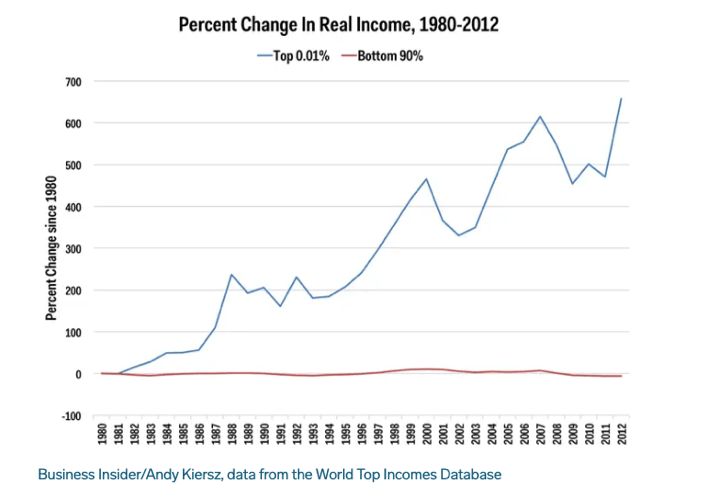
The Neoliberal conspiracy has succeeded in transferring massive wealth to the uber-elite

With the advent of the Covid-19 pandemic, this conspiracy has found yet another opportunity to squeeze wealth from the bulk of society into the hands of the few. In the United States, since the pandemic began, while 200,000 Americans have died from coronavirus and more than 50 million have lost their jobs, the collective wealth of this country’s billionaires has soared 29% to $3.8 trillion. Jeff Bezos alone could give every Amazon employee $105,000 and still be as wealthy as he was before coronavirus hit.

2. Conspiracy by transnational corporations to turn billions of people into addicts

In the 1920s, two ruthless men laid out a sinister scheme to gain control of the minds of Americans. Their plan? To identify people’s deeply buried needs and use subtle messaging to manipulate them into doing whatever they wanted without realizing it—even at the cost of their health and well-being. One of them, Edward Bernays, was Sigmund Freud’s nephew and used his uncle’s insights into the subconscious to develop his new methods. Their goal was to turn normal working Americans into manic consumers, training them to desire an ever-increasing amount of goods, and thereby converting their life’s energy into profit for American corporations. “We must shift America from a needs to a desires culture,” declared Bernays’ partner, Paul Mazur. “People must be trained to desire, to want new things, even before the old have been entirely consumed. We must shape a new mentality. Man’s desires must overshadow his needs.”

In 1928, Bernays proudly described how his techniques for mental manipulation had already permitted a small elite to control the minds of the American population:

The conscious and intelligent manipulation of the organized habits and opinions of the masses is an important element in democratic society. Those who manipulate this unseen mechanism of society constitute an invisible government that is the true ruling power of this country.
​We are governed, our minds molded, our tastes formed, our ideas suggested, largely by men we have never heard of. . . . In almost every act of our daily lives. . . we are dominated by the relatively small number of persons . . . who pull the wires which control the public mind.

Since then, this conspiracy has succeeded beyond its instigators’ wildest dreams. Corporations have perfected the technique of mind control by tweaking core human instincts that originally evolved to support our ancestors’ flourishing in hunter-gatherer bands—such as the desire for status or fear of exclusion—for their nefarious purposes.

Corporate predators have learned that the most valuable population to ensnare are children. In the sinister words of chief executive Wayne Chilicki, “When it comes to targeting kid consumers, we at General Mills . . . believe in getting them early and having them for life.” Children in the Global South are turned into junk food addicts with the same callous contempt that factory farms turn their animals into chicken nuggets. Half of the children in south Asia are now either undernourished or overweight, conditioned by pervasive advertising to spend what little money they have on the empty calories of junk food.

A new generation of mind controllers are now using sophisticated data mining technologies to inject their power even deeper into our minds. At the ominously named Stanford Persuasive Technology Lab, a modern-day Bernays named B. J. Fogg has taught budding entrepreneurs how to use “hot triggers” such as thumbs-up signs and “Like” statistics to activate short hits of dopamine in our brains that literally get us addicted to our screens. With social media now infiltrating every aspect of many teenagers’ lives, the power of predatory corporate advertising to control their minds for profit has become even more formidable. In 2017, a leaked document revealed Facebook boasting to advertisers how they can identify in real time when teenagers feel “insecure” and “worthless,” and would be most susceptible to a “confidence boost.”

3. Conspiracy to plunder the Global South for the benefit of the Global North

Ever since Portuguese and Spanish explorers set sail in the fifteenth century on a quest for wealth and power, a small population of white Europeans have conspired to use their technological advantage to despoil, plunder, and exploit the rest of the world’s wealth for their own benefit. With the Treaty of Saragossa in 1529, Spain and Portugal carved up the non-European continents between them for conquest and booty. After the Industrial Revolution, the countries of northern Europe took over the plot for global supremacy, devastating the lives of tens of millions of Africans mercilessly chained and shipped as slaves to the colonies.

After the abolition of the slave trade, the brutal exploitation continued through an international system of indentured labor. Having destroyed their livelihood in their native countries, European potentates transported more than 60 million desperate workers from India, China, and the Pacific islands to territories where they were needed, in what was frequently referred to as the “new form of slavery.” This vast global scheme of human trafficking was promoted by colonial magnates such as Cecil Rhodes who declared: “We must find new lands from which we can easily obtain raw materials and at the same time exploit the cheap slave labour that is available from the natives of the colonies. The colonies would also provide a dumping ground for the surplus goods produced in our factories.”

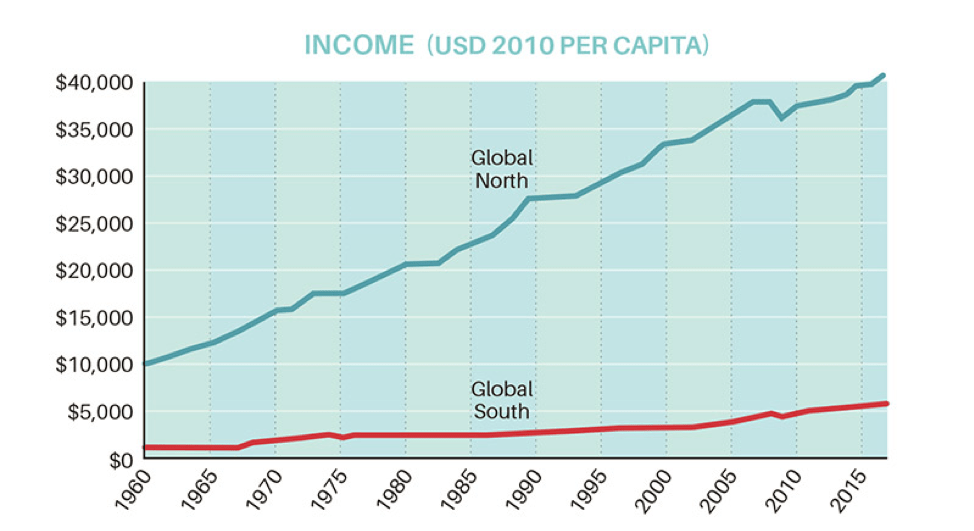
In more recent times, the plot continues in different guises. During the decades after the Second World War, Global South leaders who demanded a fair role in the economic system were systematically deposed in coups arranged by U.S., British, and French militaries. In a vast loan sharking scheme, countries impoverished by colonialism then racked up unsustainable debts forced on them by Global North banks. When they couldn’t pay them back without bankrupting their nations, they were coerced into so-called “structural adjustment programs” which opened their labor markets and natural resources to further plunder by the North’s transnational corporations. The World Bank, IMF, and World Trade Organization are all controlled by a few wealthy nations that set the terms for international trade, with the result that through a combination of illicit financial flows, debt interest payments, and profit repatriation, wealth continues to flow from the South to the North at the rate of about $3 trillion per year.


The income gap between Global North and South has quadrupled since 1960. Data from World Bank.

4. Conspiracy to hide the effects of climate breakdown for corporate profit

For over fifty years, fossil fuel executives have known about the reality of human-induced climate change, yet they spent most of that time deliberately concealing their knowledge and obfuscating public discussion on the topic so they could rake in trillions of dollars in profit. In 1968, the Stanford Research Institute alerted the American Petroleum Institute—the national trade association that represents America’s oil and natural gas industry—to the fact that CO2 emissions were accumulating in the atmosphere, and could reach 400 parts per million by 2000. Their report warned that rising CO2 levels would result in melting ice caps, rising seas, and serious environmental damage worldwide. Exxon scientists studied the issue further, reporting to management in 1977 that there was “overwhelming” consensus that fossil fuels were responsible for CO2 increases. In an internal Exxon memo in 1981, scientists raised the alarm that the company’s 50-year plan “will later produce effects which will indeed be catastrophic (at least for a substantial fraction of the Earth’s population).”

Exxon—and the other fossil fuel companies—knew their actions would lead to climate breakdown, and instead of trying to solve the problem, they lied to the public to hide their misdeeds. Following the example of the tobacco industry, which had already condemned millions to early deaths through cynical deception, they embarked on a concerted strategy to dupe the public by paying fake experts to publish papers; cherry picking selective data to support false conclusions; and sow their own wild conspiracy theories to deflect attention from their crimes.

As a result of their immoral plot, the world is now facing a dire climate emergency. If the fossil fuel companies had confronted the issue honestly from the outset, there could have been a managed transition to renewable energy over decades, causing little disruption and saving millions of lives through reduced pollution. Instead, it will now take an immediate global mobilization to avoid a 2° C rise in temperature over preindustrial levels. The world is currently on track for more than a 3° C rise this century, with the high likelihood of stumbling into a tipping point cascade that quickly leads to a three- and four-degree world—one that becomes rapidly unrecognizable, with the Amazon rainforest turning into searing desert; coastal cities inundated by flooding; super-hurricanes tearing the windows out of skyscrapers; persistent massive droughts and famine across the world; and hundreds of millions of desperate climate refugees.

Meanwhile, by putting billions of human lives in jeopardy, the four biggest fossil fuel companies—ExxonMobil, Royal Dutch Shell, Chevron, and BP—have made $2 trillion in profits since they began their campaign of lies in 1990.

5. Conspiracy to grow the global economy indefinitely, while killing most of life on Earth and risking the collapse of civilization.

In a barely noticed footnote to the daily news, the World Wildlife Fund recently released a shocking report revealing a devastating 68% worldwide decline in animal populations in the past fifty years. Even this dismal news hides more gut-wrenching statistics, such as the 84% decline in amphibians, reptiles, and fishes, or the 94% decline in animal populations in South America.

This is just the latest bulletin marking the demise of nature as it succumbs to the relentless growth of human economic activity across the world. Three-quarters of all land has been appropriated for human purposes, either turned into farmland, covered by concrete, or flooded by reservoirs. Three-quarters of rivers and lakes are used for crop or livestock cultivation, with many of the world’s greatest rivers, such as the Ganges, Yangtze, or Nile, no longer reaching the sea. Half of the world’s forests and wetlands have disappeared—the Amazon rainforest alone is vanishing at the rate of an acre every second.

Meanwhile, the world’s Gross Domestic Product is forecast to nearly triple by the middle of this century, by which time it’s estimated that 5 billion people will be facing water shortages, 95% of the Earth’s arable land will be degraded—and there will be more plastic than fish in the ocean. It’s been estimated by leading experts that, by the end of this century, half of the world’s estimated 8 million species will be extinct or at the brink of extinction unless humanity changes its ways. These depredations, combined with climate breakdown, are believed by an increasing number of analysts to spell the likely collapse of modern civilization.

The underlying cause of this headlong rush to catastrophe is our society’s obsession with economic growth as the sole criterion for measuring success. A dangerous myth of “green growth” propagated by techno-optimists argues that through technological innovation, GDP can become “decoupled” from resource use and carbon emissions, permitting limitless growth on a finite planet. This has been shown to be nothing but a fantasy: it hasn’t happened so far, and even the most wildly aggressive assumptions for greater efficiency lead to unsustainable consumption of global resources.

So who, in this case, are the conspirators? If you’re living a normal life in an affluent country, you don’t need to look further than the mirror. The wealthy OECD nations, with only 18% of the global population, account for 74% of global GDP, and the richest 10% of people are responsible for more than half the world’s carbon emissions.

Those of us who continue to benefit from the inequities dealt us by the global system, and aren’t actively engaged in curbing it, are like a few shipwrecked survivors on a gilded lifeboat kicking others desperately scrambling for life into the ocean to protect their own safety and comfort. We may not be actively kicking their knuckles, but by allowing this reckless system of unsustainable growth to continue, we’re implicitly making the same choice.

So, the next time someone tells you to “do your research” on their new conspiracy theory, please point them to the real conspiracies that are threatening life on this beautiful but troubled planet. The good news is that, since they’re real conspiracies, there is something we can do about them. We can vote in politicians that promise to peel back the neoliberal nightmare; advocate for curbs on predatory corporate activities; support the Global South in changing the terms of international trade; declare a Climate Emergency in our community to turn around carbon emissions; and become active in the movement to transform our global society to an Ecological Civilization—one that is based on life-affirming principles rather than accumulating wealth.


Jeremy Lent is author of The Patterning Instinct: A Cultural History of Humanity’s Search for Meaning, which investigates how different cultures have made sense of the universe and how their underlying values have changed the course of history. His upcoming book, The Web of Meaning: Integrating Science and Traditional Wisdom to Find Our Place in the Universe, will be published in Spring 2021 (New Society Publishers: US/Canada | Profile Books: UK/Commonwealth). For more information visit jeremylent.com.