
Published by The Club of Rome in Enduring Peace in the Anthropocene, May 2024
A just resolution to the Israel/Palestine conflict requires acknowledging and honoring truths that are seemingly contradictory. Examples from other domains show how this can be accomplished and offer a potential pathway to an enduring, long-term peace.
Let us consider some facts of historical significance generally agreed to be unequivocally true:
In the sixth century BCE, a people who became known as the Jews were expelled from their homeland in Judah to exile in Babylon. After the Persians permitted their return, the Jews repopulated the region until being exiled again by the Romans in 69 CE. Since then, a powerful cohering tradition within the Jewish diaspora centered on the prospective return to Israel (Zion), a dream that was consummated by the United Nations declaration of Israel as a Jewish state in 1947. I can attest, as a Jewish child growing up in London, to hearing the solemn invocation “Next year in Jerusalem” uttered during the annual Passover Seder service—a supplication that had echoed through generations—and sensing its fruition through Israel’s existence.
Meanwhile, in the two millennia following their exile by the Romans, other populations, mostly Muslim and Arab, inhabited the region that became known as Palestine, calling it their home. After the fall of the Ottoman Empire in the aftermath of World War I, the British Empire took control of Palestine. The Balfour Declaration, a statement of British support for “the establishment of a national home for the Jewish people,” was proclaimed in 1917, in spite of the fact that 90 percent of Palestine’s inhabitants were non-Jews.
Who, one might ask, has the historic right to live there now: the Jews, for whom it represents an ancestral homeland, or the Arabs, for whom it also represents an ancestral homeland? Since both historical narratives speak the truth, the only pathway toward a just and enduring peace would be to honor them both. How might this be possible?
A similar set of antithetical narratives has arisen around other key aspects of the Israel/Palestine conflict. In the aftermath of the Holocaust—the systematic genocidal murder of six million Jews—the United Nations, driven by a sense of collective guilt, voted to partition the region into two independent states, one Palestinian Arab and one Jewish. The Arabs rejected this enforced expiation of a crime that was not theirs, declaring war on the newly formed state of Israel. Why should the inhabitants of Palestine be forced to make reparations for Europeans’ genocidal treatment of Jews? The birth of Israel, celebrated by Jews worldwide as a culmination of two millennia of collective longing, was correspondingly the initiation of the Nakba, the ongoing catastrophe that began by violently displacing 750,000 Palestinians from their homeland, imposing an exile that remains to this day.
The contradictory claims to moral righteousness and turpitude go on and on. While the Jews forcibly dispossessed Arabs in 1948, Arab nations expelled Jews who had lived in their lands for generations, frequently confiscating all their possessions. These Jews were welcomed by Israel, which declared a Law of Return allowing for the immigration of any Jewish family to Israel—a right of return that has been denied for the Palestinians driven out by the Israelis.
Since October 7, the conflicting moral interpretations have greatly intensified: the massacre by Hamas militants of over 1,100 people, mostly civilians, was the deadliest attack on Jews since the Holocaust. Israel’s ruthless response, resulting to date in the deaths of more than 34,000 Palestinians, around two-thirds of them women and children, is widely recognized as criminally disproportionate and has plausibly been prosecuted as genocide.
While these morally contrasting narratives both hold true, and their supporting evidence is readily available, most people engaging with this topic fervently repeat one set of shibboleths while refusing to acknowledge the other—as if adding to the decibels of one side will somehow drown the other into submission. Such a tactic might lead to short-term gains, but never to an enduring peace. For those who envision a long-term future where both Jews and Arabs can live together harmoniously in what both consider to be a Holy Land, what approach might offer a pathway forward? Let us begin to answer this question from a foundational perspective.
Holding and honoring conflicting truths
The dominant Western worldview arises from an ontology that takes an absolutist view of truth. If something is right, then it cannot be wrong. If it’s black, then it can’t be white. In ancient Greece, Parmenides first established the iron rule of systematic logic, which was further elaborated by the deductive reasoning of Aristotle to form a foundation for scientific thought. Alongside these developments, the religious absolutism of monotheism took root, claiming for the first time in the human experience that only one God existed, and all those who did not worship Him were sinners. Before the rise of monotheism, intolerance based on religious creed was virtually unknown.
This ontology, however, is not the only one available. Even among the Greeks there were those, such as Heraclitus, who claimed that “We both are and are not.” While systematic logic won out in the West, other cultural complexes such as Buddhism, Taoism, and many Indigenous traditions developed equally sophisticated conceptions of the universe that were more fluid. For example, the Huayan school of Buddhism, which flourished in Tang dynasty China over a thousand years ago, understood reality as an all-embracing web of causal relations between things. The Huayan philosophy emphasized that the significance of any object depends on how it’s approached, with the result that phenomena could be interpreted in multiple ways without one interpretation invalidating the other. In the words of an old, wise adage: “We don’t see things as they are, we see them as we are.”

This approach, at odds with Aristotelian logic, re-emerged in Western thought in the twentieth century as physicists, grappling with the paradox of quantum mechanics, realized that subatomic entities may be either a wave or a particle depending on how they’re measured. More generally, the wide array of modern systems sciences—including such fields as complexity theory, chaos theory, systems biology, and network theory—recognizes that complex systems manifest multiple layers of interactivity. While certain principles may hold true throughout the system, different parts within the system may exhibit behaviors that appear contradictory to other parts, even while all are contributing to the integrity of the system as a whole. Accordingly, a healthy living system represents a state of integration which may be understood as unity incorporating manifold differentiation.
The embrace of complexity has shown up more recently in therapeutic psychology, with the widespread adoption of parts work, based on the recognition that people hold different parts within themselves, some of which may contradict each other causing inner conflict. As Walt Whitman famously declared: “I am large, I contain multitudes.” In particular, Internal Family Systems (IFS) is a transformative therapy that helps people heal by accessing and honoring their inner parts, some of which are wounded, protective, aggressive, or defensive. Recognizing that these parts are frequently at odds with each other, which causes internal suffering, IFS emphasizes the importance of a core Self in a person which, if accessed skillfully, can attend with love to each part and encourage healing—not by rejecting those parts but by allowing them to feel acknowledged and become integrated into the greater whole.
There is much that could be achieved by applying this wisdom to the political process. What kind of political discourse might arise with respect to Israel and Palestine if such an approach were taken?
An integrative pathway to peace
Comparable to the Self in IFS, there are overriding values shared by virtually all human beings that transcend the parochial in-group values dominating the current political debate. In the resounding words of the UN Declaration of Human Rights—proclaimed the year following Israel’s birth as a nation—“Recognition of the inherent dignity and of the equal and inalienable rights of all members of the human family is the foundation of freedom, justice and peace in the world.” Acknowledging that “disregard and contempt for human rights have resulted in barbarous acts which have outraged the conscience of mankind,” the Declaration calls for “a world in which human beings shall enjoy freedom of speech and belief and freedom from fear and want … as the highest aspiration of the common people.”
Tragically, since 1948, Israeli forces have trampled on these rights of Palestinians, while many Arab nations and political groups have similarly flouted them. A few days after the October 7 massacre by Hamas and the initiation of Israel’s criminal collective punishment, author and social activist Naomi Klein called for a global response “rooted in values that side with the child over the gun every single time, no matter whose gun and no matter whose child.” This is the kind of deeply humanitarian orientation that is required for an integrative pathway to peace.
We must recognize that a humane response to the enormity of the Holocaust did not have to lead to an Israeli ethno-state. As essayist Pankaj Mishra has demonstrated, many Jewish leaders surviving the Holocaust took the phrase “never again” to mean “Never again for any persecuted minority anywhere in the world” rather than “Never again for the Jews.” Nonetheless, we must appreciate that Israelis today continue to live under a constant existential threat with powerful enemies repeatedly calling for their annihilation. The Israeli political leadership, however, has thrived on weaponizing fear, using it to motivate fervid allegiance to Zionism in many Jews around the world, and currently fomenting a worldwide conflation of anti-Zionist protests with anti-Semitism, in spite of the fact that many Jews join in the public outrage at Israel’s brutal campaign.
When we engage in political discourse, we must choose our words carefully to avoid adding to the polarized grandstanding dominating the media. As journalist Judith Levine has pointed out, the mindless use of blanket terms such as “pro-Israel” or “pro-Palestinian” only serves to smother the deeper issues of human rights under a cacophony of tribal rivalry.
We must call urgently for a ceasefire in Gaza and a return by Hamas of all hostages. At the same time, we must recognize the deep power imbalance currently existing between the state of Israel and the Palestinians living in the occupied territories, and demand the end of Israel’s abuse of its military superiority. We must call for an end to the illegal Jewish settlements in the West Bank, and to the fanatical Jewish paramilitary gangs currently terrorizing Palestinian villagers with the tacit—and sometimes open—support of Israeli armed forces. And when the current hurricane of violence subsides, we must call for a Truth and Reconciliation Commission, modeled on exemplars from South Africa, Rwanda, and Canada, and employing principles of restorative justice, that could facilitate a new generation to face into and move on from the current round of anguish toward a healed society.
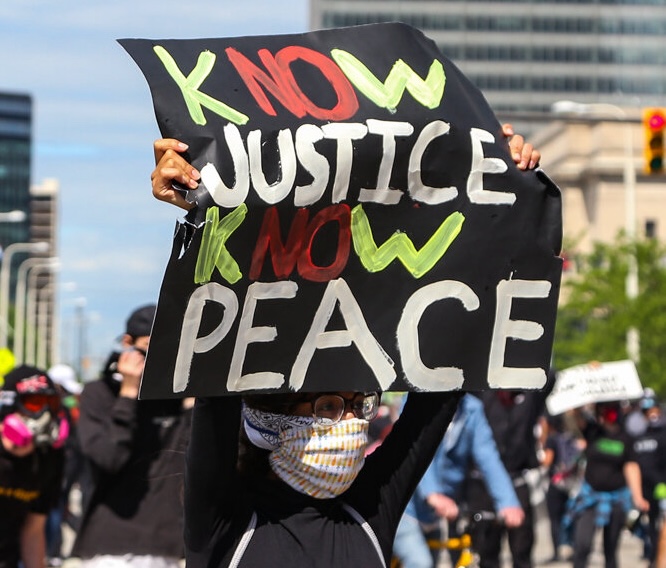
Above all, an integrative pathway to peace calls for the boldness to imagine a transformed future for this divided region and to support those groups, currently nearly drowned out by the polarized voices on both sides, taking the first courageous steps in that direction. The Standing Together movement, which mobilizes Jewish and Palestinian citizens of Israel in pursuit of peace, equality, and justice, envisions building a shared home for all through rejecting hatred and choosing compassion. Combatants for Peace is a grassroots nonviolence movement based in Israel and Palestine—the only peace movement in the world founded by former fighters on both sides of an active conflict. The Holy Land Trust, a Palestinian organization dedicated to fostering peace, justice, and understanding in the Holy Land, is committed to nonviolent activism, along with personal and spiritual transformation arising from honoring the dignity and equal rights of all peoples.
Beyond the horizon, an integrative path has the potential to lead to political solutions that are currently almost unimaginable. A movement of Israelis and Palestinians called A Land for All, acknowledging that both peoples belong to the same ancestral land, envisages a shared homeland encompassing two sovereign states. Their proposal calls for two democratic states based on pre-1967 borders, with citizens of both states given the right to move and live freely in all parts of the homeland. With Jerusalem as a shared capital, both states would be responsible for the security of their residents, would enter into a mutual defense treaty against external threats, and would share a Human Rights Court empowered to rule on alleged violations of rights by non-citizen residents of either country. While current political and cultural conditions render such an arrangement unworkable on many counts, this is the kind of integrative visionary thinking that will be required to enable an enduring long-term peace for a region that has suffered too much torment throughout its embattled history.
Jeremy Lent is author of the prize-winning books The Patterning Instinct and The Web of Meaning. He is founder of the Deep Transformation Network and is currently writing a book on the vision and specifics of an ecological civilization. Author website: jeremylent.com
 Patterns of Meaning
Insightful interdisciplinary thinking, Jeremy. As is so often the case for me, my appreciation for such insightful analysis is shadowed by the sad, seemingly intractable fact that, as you say, “…current political and cultural conditions render such an arrangement unworkable on many counts….” Yet, as hard as it is to see a path forward, we must continue, one step at a time, to create that path.
LikeLike
Hello Jeremy –
Always great to hear from you.
Slight correction for your benefit:
Modern Parts Work probably began with psychiatrist and psychoanalyst Dr. Roberto Assagioli (1888 – 1972) , who created Psychosynthesis (https://www.psychosynthesis.org/about/history/). Around the same time, Gestalt psychology was using parts work extensively. 50 years ago, Drs. Hal and Sidra Stone independently developed a widely-used parts work form called Voice Dialogue. They did not make it exclusive to therapists, they spread it to anyone who wanted to learn it. Then Schwartz came along and re-invented it in his own image, and made it the exclusive domain of therapists, and now suddenly it’s the big deal.
Read the book, “Your Symphony of Selves” by Jim Fadiman and Jordan Gruber. They document the MANY forms of parts work, including shamanism, that predate IFS. IFS is the Johnny-come-lately in this field, but they pretend to have invented it.
Lion
Lion Goodman, PCC
Clear Beliefs Institute http://www.ClearBeliefs.com 1.707.971.7947 Lion@ClearBeliefs.com
>
LikeLike
I do not agree with your statement that both peoples (Israelis and Palestinians) belong to the same ancestral land, and that integrative visionary thinking envisages a shared homeland encompassing two sovereign states. It would be far more visionary and inspiring if we could imagine people’s cherished identities as distinct and unattached from a sovereign state whose only function should be to serve all its citizens.
My Jewish identity does not entitle me to claim the land of the Bible as my ancestral home. I am a citizen of a sovereign state in the UK. Belief in the eventual coming of the Messiah and the return to the land of Israel is a basic and fundamental part of traditional Judaism and has been for the last 2000 years. The political and spiritual redemption of the Jewish people by bringing them back to Israel and restoring Jerusalem is a religious belief. The Messiah will establish a government in Israel that will be the center of all world governments, both for Jews and gentiles. He will rebuild the Temple in Jerusalem and re-establish all of its services. He will restore the religious court system of Israel and establish Jewish law as the exclusive law of the land. He will cause all nations to be filled with the knowledge of God.
There have been false Messiahs in the past. The Zionist movement is a modern false Messiah. A much more visionary and realistic vision is the One Democratic State Initiative, which I quote from below:
The Zionist settler-colonial endeavor to establish a Jewish state in Palestine has come at the cost of untold suffering —oppression, dispossession, massacres, forced displacement, apartheid, occupation, and others— to the Palestinian people. As a movement that politicizes identity and segregates on its basis, Zionism has further proven to be a danger to the cohesion and health of societies already plagued with sectarianism beyond the borders of Palestine.
The “two-state solution” has proven not to be a solution at all. Neither can one identitarian aspiration be fought with another. The fundamental antithesis to the Zionist project can only be a project that depoliticizes identity: The establishment of one democratic state, for all its citizens, from the river to the sea. The purpose of this initiative is thus to mobilize individuals, entities and political parties, in Palestine and abroad, behind such an endeavor.
LikeLike
The following thought-experiment I wrote in 2004 explains why I am unimpressed with the claim that Jews are entitled to a Jewish homeland. Adventures with the Bible
LikeLike
This part of your text jumped out at me. “I’ve been free to live my Jewishness in whatever way I chose. I can see no benefit to me of having a Jewish state which by definition must exclude everyone who is not Jewish.” Hooray that you have been free to live your life. I’m sure you know that millions of Jews have not had that freedom. There is no guarantee that you will continue to have that freedom. The state of Israel gives Jews around the world a refuge, a place to feel safe. During the Holocaust, no country wanted to take in Jewish refugees. Israel will always take in Jewish refugees. That is the benefit of a Jewish state.
Let’s work on making a world where everyone has a place of refuge.
LikeLike
You stated: “The state of Israel gives Jews around the world a refuge, a place to feel safe.” I agree that many Jews around the world want and need a place to feel safe and many believe, even after 7 October, that the state of Israel should provide such a refuge. The tragedy is that the state of Israel has not succeeded. The tragedy is that Jews living in Israel do not feel safe. They live in a state of existential fear of persecution because they are Jews. I quote from a letter written in 2008 by an Israeli Jew living in Israel to the international community:
“There is no child in Sderot (an Israeli town close to the Gaza border) under the age of 10, who knows any other existence than that of daily fear of a bomb landing on his home, school, or shopping mall. When was the last time you ran for your life to a shelter to avoid being bombed? When was the last time you realized that your child will need a psychologist to help overcome his/her fears of loud noises and sirens? When was the last time your house had a near miss of a rocket fired at you, or worse, had your house crumble under the impact of a mortar shell? When was the last time that you could not tend to your crops, because the last time you went out to your fields you were fired on by snipers? When was the last time that your child saw your neighbor lying in a pool of blood? When was the last time you made sure your child had armed escort when he went on school outing?”
I’ve been to Israel 3 times (1968, 2002, 2005). Every time, I met Israeli Jews who talked about how unsafe they felt as Jews. Of course, there is anti-semitism in Britain but I have never experienced anything like the fear that Israeli Jews feel. In 2014, a meeting was held at my synagogue to talk about how unsafe we felt as Jews in the UK. Not one person could come up with a single example of anti-semitism directed at them as Jews, other than anti-Israel protests. It seemed to me that the state of Israel made all of us feel less safe.
Especially since 7 October, I am surprised that you can still say that the state of Israel gives Jews around the world a place to feel safe. Israel must be the least safe place to be a Jew in the entire world.
I wonder how different it would be today if a less militant form of Zionism had predominated in 1948. If, instead of dispossessing and oppressing the Palestinians, the Jewish refugees from WWII had joined with Palestinians to create a secular, democratic state with liberty and justice for all. I believe the Jews who chose to live in such a state would feel safer than they do in a ethno-nationalist Jewish state.
LikeLike
You feel safe now. But if conditions changed and you suddenly found yourself in the equivalent of 1930’s Germany, what would you do? At least Israelis have the ability to fight back. It is not unthinkable that a new holocaust could happen in the US or the UK.
It will take both sides to bring peace to the Middle East. Arab extremists will not accept a secular democratic state any more than they accept a Jewish state.
LikeLike
I love your visionary thinking, Jeremy, and loved the panel you convened for the April DTN meeting as well. “None of the above” — an entirely new approach — is what’s needed, as you say. The Peace and Reconciliation piece is a brilliant addition to the new vision we need to evolve in places of conflict, at least I hadn’t seen it proposed as a part of the Israel-Palestine solution yet.
I just do want to quibble a tiny bit with your statement that “Nonetheless, we must appreciate that Israelis today continue to live under a constant existential threat with powerful enemies repeatedly calling for their annihilation.” Yes Arab countries have persisted in their refusal to recognize “the right of Israel to exist” (as if any nation state has some cosmic right to exist, but that’s another essay). But “powerful?” I think that myth was debunked during the Six Days War in 1967, wasn’t it? And the Israeli military has grown exponentially more powerful since then.
In any case, with the US as an ally in case of actual attack and existential threat (which October 7 doesn’t qualify as, heinous as it was), how could they be seriously worried? It’s Zionist fearmongering, nothing more. Despicable, as has been the Palestinian leadership for decades, using the refugees as a political football in their game for regional power. As for the Iranians, they could care less about Palestinians, not being fellow Arabs, and if anyone thinks they know what Iran is up to in general, other than wanting keep maintain a balance of power in the region, I think they’re a bit delusional.
Anyway, back to the appreciation for what you wrote for the Club of Rome — that your thinking is being platformed is something to take heart from and carry on the work of bringing about an ecological civilization, which encompasses so much more than “environmental” issues. Thanks again!
LikeLike
Thank you for this wonderful example of how values espoused in aspirational declarations (such as UN Human Rights) could be substantiated in practice. I subscribe to systems thinking and teach it as part of an education for transformation course at the postgrad level for teachers. The more people who voice views such as expressed in this article, the more the vision may take hold so I will add this article to the reading list of the course. Thank you again.
LikeLike
Responding to Jeremy Lent’s article:
Honoring Multiple Truths: An Integrative Pathway to Peace in Israel/Palestine
https://patternsofmeaning.com/2024/05/21/honoring-multiple-truths-an-integrative-pathway-to-peace-in-israel-palestine/
Lent states, “Meanwhile, in the two millennia following their exile [Jews from Palestine] by the Romans, other populations, mostly Muslim and Arab, inhabited the region that became known as Palestine, calling it their home.”
It is ridiculous to allude to that as an “irregularity.” The absence of Jews for two thousand years eliminates any justifiable claim to the territory occupied by others in their absence.
Lent, “After the fall of the Ottoman Empire, in the aftermath of World War I, the British Empire took control of Palestine. The Balfour Declaration, a statement of British support for “the establishment of a national home for the Jewish people,” was proclaimed in 1917, in spite of the fact that 90 percent of Palestine’s inhabitants were non-Jews.”
It is important to read The Balfour Declaration (1)
The Balfour Declaration’s stipulation to leave the existing inhabitants alone was ignored by Zionists.
Much of Israeli history is rewritten by Zionists to rename preemptive military interventions as defense.
Lent, “Who, one might ask, has the historic right to live there now: the Jews, for whom it represents an ancestral homeland, or the Arabs, for whom it also represents an ancestral homeland? Since both historical narratives speak the truth, the only pathway toward a just and enduring peace would be to honor them both. How might this be possible?”
There is no moral equivalence between Israeli Zionism and the rightful inhabitants of Palestine.
Two thousand years of absenteeism eliminates the Jewish Zionist justification for a renewed occupation. Theocratic Zionism is fascism.
Fascism is the privatization of government by private concerns, be those private concerns secular or theocratic, or both. From that condition of impunity, then, classic, fascist, necrophilic tactics are deployed.
Zionism has controlled the Israeli government since 1948. Theocratic Zionism began its genocide of non-Jews in Israel from day one. The Zionist hallmark of “greater Israel,” continues fueling the Zionists genocide of Palestinians.
Lent, “…the massacre by Hamas militants of over 1,100 people, mostly civilians, was the deadliest attack on Jews since the Holocaust.”
Between 1947 and 1949 …Zionist forces had killed about 15,000 Palestinians in a series of mass atrocities, including more than 70 massacres. (2)
The October 7 military intervention on the part of Hamas was provoked, and anticipated by the Zionist Israeli government, three weeks in advance. No actions were taken to prevent it. Knowing Israeli civilians would be killed; The Zionists wanted that attack as “justification” for ending the “Palestinian problem” with unrestrained genocide. All Palestinian resistance to genocide is termed “terrorism” by Israeli Zionists.
It is sickening to see the Israelis subjected to false education and propaganda that makes them psychotic; never mind the “settler’s movement,” which is composed of criminal psychopaths.
I will not be accused of taking sides. Fascism by any stripe is the crime against humanity, be that Israeli Zionism, European fascism, or the American Republican Theocratic Fascist Party. Fascism is the enemy of humanity, and of Life.
Lent is in error to assume “conflicting truths,” where none exist. There is no rightful claim to Palestinian Land by Israeli Zionists harkening back to their religious mythos, especially after two thousand years of absence.
The oriental contemplative disciplines are unconcerned with civilization. Having been an Indigenous, cultural attribute, living in the Dao has long since lost relevance in China. No patriarchic, monotheistic system of control is Indigenous. The Axial Age saw the institutionalization of patriarchic religions for the purpose of consolidating power, theocracies, as well as for the enslavement of women.
Lent’s intriguing report on oriental philosophy contributes nothing to the geopolitical challenges that beset us. He concludes with “Accordingly, a healthy living system represents a state of integration which may be understood as unity incorporating manifold differentiation.” However, that precept is inapplicable to western civilization, and is out of context.
Lent’s reflections on “therapeutic psychology” have no bearing on the geopolitical conditions that confront us. I have studied psychology and “depth psychology.” The importance of a sound Self and subjective individuation is irrefutable. Nonetheless, a sick society produces sick people (Eric Fromm). History demonstrates that the sole means to defeat fascism is with force.
Lent, “An integrative pathway to peace”
Lent condemns state directed genocide.
Lent correctly points out that the Zionists conflate, “… anti-Zionist protests with anti-Semitism…” (There are pissing, shitting devils in power, masquerading as men.)
Fascist tactics include inducing false fears, which causes psychosis.
Lent, “When we engage in political discourse, we must choose our words carefully to avoid adding to the polarized grandstanding dominating the media…”
The “polarized grandstanding dominating the media,” mentioned by Lent, is all about defending the Israeli government. Directly after October 7, I stated that the Israeli Zionists were engaged in genocide. Lent responded by telling me that the term “genocide” was too severe, that such was not the case. Later, Lent objected to my having referred to Netanyahu as a devil, at which point, I demonstrated to him the facts of psychology to that effect. Yes, choosing words carefully is important, but stating the facts, no matter how unseemly to some, is the correct approach to the situation.
Lent, “….we must call for a Truth and Reconciliation Commission”. That will never happen as long as Zionist fascists control the Israeli government, and while the American ‘Christian’ Zionists in American government continue deploying arms to Israel.
Since 1948 Israeli Zionists have disrupted all sincere initiatives for whatever plausible negotiations. Evil men command state, military power, single minded, to destroy all Palestinians, and then to invade surrounding countries for “greater Israel.” Those men are criminals who do not respond to “nonviolent activism,” except with their police state. While one side of this “issue” is composed of the criminally insane, no political solution is possible.
Lent, “While current political and cultural conditions render such an arrangement unworkable on many counts, this is the kind of integrative visionary thinking that will be required to enable an enduring long-term peace for a region that has suffered too much torment throughout its embattled history.”
“…this is the kind of integrative visionary thinking that will be required…” (As if Lent’s kind of thinking will be required)
Only after the Israeli fascist Zionists controlling the Israeli government have been “put to the knife” can any of that “visionary thinking” come into play. Jeremy Lent must be patient, because regime change for Israel is not forthcoming. Starving Palestinians into extinction is taking longer than I predicted last October. At the advent of the “Palestinian problem” behind them, with all Palestinian survivors “herded” into the Sinai, then Israeli Zionists will begin invading neighboring countries. Unless American support for Israel is suspended, there is no end in sight for Zionist fascism.
Reed C. Kinney
Notes:
Note, 1:
“Foreign Office November 2nd, 1917 Dear Lord Rothschild: I have much pleasure in conveying to you. on behalf of His Majesty’s Government, the following declaration of sympathy with Jewish Zionist aspirations which has been submitted to, and approved by, the Cabinet: His Majesty’s Government view with favor the establishment in Palestine of a national home for the Jewish people, and will use their best endeavors to facilitate the achievement of this object, it being clearly understood that nothing shall be done which may prejudice the civil and religious rights of existing non Jewish communities in Palestine, or the rights and political status enjoyed by Jews in any other country. I should be grateful if you would bring this declaration to the knowledge of the Zionist Federation. Yours, Arthur James Balfour” [underlined mine]
Note, 2: https://www.aljazeera.com/features/2017/5/23/the-nakba-did-not-start-or-end-in-1948
LikeLike