Complexity, Cooperation, and Civilization

Many people claim that evolution has a direction toward increased complexity—and that humans represent its apex. Our destiny, they declare, is to break out of our earthly limitations and explore the galaxy. Although an intoxicating vision for some, the rise of human civilization has been a double-edged story. Until humans learn to enhance life on Earth rather than destroy it, we’re not ready ethically to reach for the stars.

Excerpted from The Web of Meaning: Integrating Science and Traditional Wisdom to Find Our Place in the Universe (published earlier this month in the UK, and available July 13 in the US),

Complexity, cooperation, and civilization

Life’s glorious triumph on Earth has been achieved, not just through increased complexity, but also increased cooperation. In fact, the two go hand in hand. When individuals cooperate, it allows them to specialize in what they do best, thus promoting diversity and greater complexity. Whether it was single cells combining to create multicellular organisms, or insects collaborating to form colonies, the great phase transitions of life have all required massive upsurges in cooperation.

Many researchers have pointed out that building cooperation doesn’t come easily. A perennial problem for cooperating groups throughout the history of life—whether bacteria, organisms, or communities—is the risk of freeloaders: those that take advantage of the benefits of the group without making their fair contribution. If there are too many of them, they undermine the effectiveness of the group and may cause it to disintegrate. Genetic relatedness is one way evolution solved this problem: cells and organisms evolved to cooperate more closely with others that share their genes. But cooperation extends far beyond genetic affiliation.

Ultimately, the crucial success factor for cooperation at increasing levels of scale is integration—a state of unity with differentiation. In a fully integrated system, each part maintains its unique identity while operating in coordination with other parts of the system. To do so, the parts must remain in intimate feedback loops of communication with a large number of related parts.  Each of the systems we’ve been looking at—cells, organisms, ecosystems, and Gaia—is a paragon of this type of integration. In fact, integration is a defining characteristic of any purposive, self-organized entity.

As life succeeded in integrating ever larger systems, it kept improving its negative entropy (or negentropy): the process of turning entropy into islands of self-organization that is a defining feature of all living systems. Larger animals utilize energy more efficiently than smaller ones, and larger colonies of insects are more effective at staving off entropy than smaller ones. The rise of human civilization itself may be portrayed as a series of enhancements in energy utilization. Agriculture, as anthropologist Leslie White has laid out, harnessed the negentropy of horses, cows, and sheep, who spent their days consuming the sun’s energy stored in plants, and then made it available to humans in the form of work, milk, wool, and meat. Further technological advances allowed humans to exploit the energy of the natural world ever more efficiently.

As with the other great phase transitions of life, underlying humanity’s achievements in agriculture and technology was an increase in cooperation. Humans are by far the most cooperative of primate species, and this—more than any other factor—is the key to our species’ success. As pre-humans evolved in bands of nomadic hunter-gatherers, they developed a sophisticated social intelligence, enabling them to collaborate closely with each other. Early hominids also faced the freeloader problem, and the characteristics they evolved to solve it became an intrinsic part of human nature: a powerful instinct for fairness, combined with a drive to punish those who flagrantly break the rules, even at one’s own expense. Many of the qualities we prize in a person, such as compassion, generosity, honesty, and altruism, are the results of our hunter-gatherer ancestors evolving the aptitude to collaborate successfully as a group.

The human instinct to cooperate has been key to our species’ success

Like earlier evolutionary transitions, enhanced cooperation in humans enabled greater specialization. Soon after the emergence of agriculture, cities appeared, replete with all kinds of specialists—artisans, healers, warriors, and priests—who, by plying their unique trades, together formed the backbone of civilizations around the world. Like insect colonies, cities become more efficient at negentropy the bigger they get. With each doubling of population size, a city only needs about 85% more infrastructure, such as roads, water pipes, gas stations, and grocery stores. In fact, a city can be understood as a form of superorganism, showing many of the self-organized characteristics that we’ve come to see in all living entities ranging from cells to ecosystems.

The scale of human connectivity, of course, extends far beyond individual cities. In the modern era, with instant global connectivity through the internet, humans have woven a worldwide web like nothing Earth has seen in its entire existence. Does humanity’s ascendancy represent the next step in life’s continued evolution toward ever greater complexity? Thoughtful observers of different stripes—scientists, philosophers, and visionaries—answer with a strong affirmative. Evolution, they claim, has a direction. From bacteria to eukaryotes to multi-celled organisms, from plants to reptiles and then to mammals, life, they argue, has a destiny that culminates inevitably in the emergence of creatures like us—possessing complex brains with the ability to become self-aware and perhaps ultimately direct our own future evolution toward even greater complexity.

It’s an intoxicating vision for some. However, if we look more closely into this narrative, we find it contains elements that are not quite as triumphant as we might wish. It’s a doubled-edged story—and those edges form the parameters of much that we’ll explore later in this book.

Eligible for the Federation?

The idea of inevitable progress as a cosmic law traces its pedigree back to seventeenth-century Europe, but it was a twentieth-century visionary, theologian-cum-paleontologist Teilhard de Chardin, who gave it a scientific tincture, tying it in to modern evolutionary theory. Pointing to the increasing complexity of life, Teilhard triumphantly placed humanity at its apex. “Life physically culminates in Man,” he wrote, “just as energy physically culminates in life.” Teilhard saw this inevitable progression continuing toward what he called the Omega Point—the ultimate stage of evolution in which all distinctions between artificial and natural are dissolved, when humanity’s consciousness will fuse with the entire natural world to form one unified organism of embodied intelligence.

More recently, leading techno-visionaries have taken up Teilhard’s vision but jettisoned nonhuman nature from the grand narrative. In his bestseller, The Singularity Is Near, Google executive Raymond Kurzweil prophecies a future where humanity’s conceptual intelligence fuses with machines, leaving animate existence in the dust. “There will be no distinction, post-Singularity,” he declares, “between human and machine or between physical and virtual reality.” Similarly, prominent physicist Max Tegmark views the inevitable appearance of super-intelligent AI as Life 3.0—overcoming the physical constraints of human beings (“Life 2.0”) and the rest of nature (“Life 1.0”). Frequently, these visions foresee a future intelligence leaving Earth behind, expanding through the Milky Way and then into other galaxies, spreading the higher consciousness and advanced intelligence required for converting the entire universe into a font of negative entropy, perhaps even one day, in the far distant future, repealing the Second Law of Thermodynamics itself.

There is something wildly inspirational in this kind of vision, yet it contains a foundational flaw that must be identified and fixed before it could ever take off. Since these visions extend into the realm of imagined futures, it seems fitting to approach them from the perspective of one of science fiction’s best-loved sagas—the Star Trek series. As Star Trek fans (I’m one of them) can attest, the future it envisages, with all its challenges and existential threats, is largely benevolent on account of the values of the United Federation of Planets. The Federation only allows other planetary civilizations to join if, after a thorough evaluation, they meet its ethical criteria, which include an affirmation of “the fundamental rights of sentient beings,” and faith “in the dignity and worth of all lifeforms.”

Would our current civilization be eligible to join the Star Trek United Federation of Planets?

Would our current civilization be eligible to join the Federation if they evaluated us today? The only realistic answer is an emphatic “No.” Quite apart from the extreme inequities among our own species, forcing billions to live without basic rights such as a home, education, or food security, humanity has been systematically destroying the welfare of other sentient beings on Earth without any regard to their dignity or worth. The rollcall of humanity’s depredations against nature is vast. Some of our most egregious transgressions would have to include the willful torture of billions of domesticated animals in factory farms; the vast demolition of wildlife habitat; the pollution of Earth’s waterways and oceans; the indiscriminate use of deep sea trawlers that decimate fish populations; and the massive conversion of vibrant ecosystems into huge monocrop plantations. The list goes on and on. As a result of the boundless havoc caused by our global civilization, Earth is now experiencing the sixth mass extinction of species since life began on our planet. The sorrowful reality is that, if humanity did succeed in developing the technologies to explore the universe, without first changing its ethical moorings, then a dismal fate would await other less powerful sentient beings out there. If Federation officials were to consider us for entry at this stage in human history, we wouldn’t stand a chance.

Far from being the next step in life’s evolution, humanity’s ascendancy in its current form represents a major step in the wrong direction. We can comprehend this better when we consider the importance of integration as the key to life’s success in continually improving negentropy. In a truly integrated system—consistent with Federation ethics—each entity possesses intrinsic dignity and worth, pursuing its own purpose as part of the larger whole. Our civilization, however, has built its relationship with the rest of nature, not on integration, but on dis-integration. It is based on dominating the natural world with no consideration for its wellbeing. Through our irresponsible use of fossil fuels, we have created imbalances in Gaia’s own health that are causing pernicious damage to countless species as well as our own. Through our conversion of ecosystems into monocrops, poisoning of waterways, annihilation of coral reefs, and emptying the oceans of fish, we are quite possibly the greatest force for entropy that Gaia has experienced in billions of years. Rather than integrating with the rest of life, as Teilhard may have envisaged, we are ruthlessly destroying life, eradicating its precious complexity—and are doing so at an ever-accelerating pace.

There are some who, appalled by our species’ impact on the living Earth, consider humanity to be like a malignant cancer consuming Gaia. While this may be a fair depiction of our current civilization, it certainly need not hold true for humanity as a species. The rise of conceptual intelligence in humans has given us exceptional powers that can be used both beneficially and destructively. However, just as we’ve seen how each of us can develop an integrative intelligence that combines our embodied experiences, humans collectively have the potential to develop a far more integrated relationship with the rest of nature. Technology doesn’t have to be used to destroy the complexity of living systems—if established on a different ethical basis, it could be developed to work in harmony with natural processes, promoting Gaia’s overall negentropy.

Through the rest of this book, we’ll explore what it means to live in a way that enhances life’s deep purpose rather than working against it. We’ll discover how, as a civilization, we have the potential to follow a path of integration that could lead to symbiotic flourishing for humanity and Gaia together—a path that just might lead, one day in the distant future, to being welcomed into the United Federation of Planets with open arms.


Explore The Web of Meaning further on Jeremy Lent’s website. The book is available for purchase now in the UK and preorder in the USA/Canada.

Introduction to The Web of Meaning

As our civilization careens toward a precipice of climate breakdown, ecological destruction, and gaping inequality, people are losing their existential moorings. Our dominant worldview has passed its expiration date: it’s based on a series of flawed assumptions that have been superseded by modern scientific findings.

The Web of Meaning: Integrating Science and Traditional Wisdom to Find Our Place in the Universe (published this week in the UK, next month in the US), offers a coherent and intellectually solid foundation for an alternative worldview based on deep interconnectedness, showing how modern scientific knowledge echoes the ancient wisdom of earlier cultures.

Here is the Introduction.

Tea with Uncle Bob

We could call it The Speech. You’ve probably heard it many times. Maybe you’ve even given it. Every day around the world, innumerable versions of it are delivered by Someone Who Seems to Know what they’re talking about.

It doesn’t seem like much. Just another part of life’s daily conversations. But every Speech, linked together, helps to lock our entire society up in a mental cage. It might occur anywhere in the world, from a construction site in Kansas to a market stall in Delhi. It can be given by anyone old enough to have learned a thing or two about how it all works. But it’s usually delivered by someone who feels they’ve been around the block a few times and they want to give you the benefit of their wisdom.

Because I grew up in London, I’ll zoom in there to a particular version of The Speech that reverberates with me. It’s an occasional family gathering—one of those events where toddlers take center stage and aunties serve second helpings of cake. It’s tea-time, and a few of us are gathered around, talking about the state of the world. Someone comments on what’s wrong with our system and how things could be so much better—but Uncle Bob happens to be in the group, and before you know it, it’s too late. The Speech is about to begin.

“Let’s face it,” Uncle Bob declares to the group, “it’s a dog-eat-dog world out there. Every man for himself. For all your ideas about making the world a better place, when it comes down to it, everyone’s just interested in their own skin. It’s a rat race. That’s the way all of nature works. That’s how we’ve been programmed. The survival of the fittest.”

Does any of this sound familiar to you? It’s only too familiar to those of us at the tea party. Uncle Bob sees some glazed faces looking back at him, so he feels the need to add a few more pointers to his oration.

“Look,” he leans forward conspiratorially, “it’s like this. People like you want to change the world. But when you’ve had the experience I’ve had, you’ll know better. Our society is structured this way simply because that’s what works best. They tried communism—and you know what happened to that. For all the complaining people do, they’ve never had it so good. Look at our amazing technology, look at all the progress we’ve made in the past few hundred years. You can thank capitalism for that. The fact is, it works so well, because at the end of the day people are selfish—they look out for themselves. Capitalism takes that selfishness and turns it into progress—it lets people become entrepreneurs, which makes all of us better off. That’s what they call . . . the invisible hand, isn’t it?”

Game over. Whatever ideas were being floated about improving society just wafted out the window. Uncle Bob pauses. The conversation comes to a halt, until someone pipes up: “How’s little Penny doing with her dancing lessons?”—and the tea party rolls on.

This type of conversation takes place with regularity around the world because it channels the themes we hear every day from those in a position of authority—from talking heads on TV, from successful businesspeople, from teachers, from school textbooks. Even when the Speech is not given explicitly, its ideas seep into our daily thoughts. Every time a newscaster reports on prospects for economic growth; every time a TV commercial hypes the latest consumer product; every time an exciting new technology is touted as the solution to climate change, the underlying themes of the Speech insidiously tighten their grip on our collective consciousness.

Talking heads collectively reinforce our dominant worldview

The flaws in our dominant worldview

Distilled to their essence, these themes come down to a few basic building blocks: Humans are selfish individuals. All creatures are selfish—in fact, selfish genes are the driving force of evolution. Nature is just a very complex machine, and human ingenuity has, for the most part, figured out how it works. The modern world is the spectacular result of technology enabled by the market forces of capitalism, and in spite of occasional setbacks, it’s continually improving. There may be problems, such as global poverty or climate change, but technology, powered by the market, will solve them—just as it always has in the past.

These basic elements, give or take a few, form the foundation of the predominant worldview. They infuse much of what is accepted as indisputably true in most conversations that take place about world affairs. They are so pervasive that most of us never question them. We feel they must be based on solid facts—why else would all those people in positions of authority rely on them? That’s the characteristic that makes a worldview so powerful. Like fish that don’t realize they’re swimming in water because it’s all they know, we tend to assume that our worldview simply describes the world the way it is—rather than recognizing it’s a constructed lens that shapes our thoughts and ideas into certain preconditioned patterns.

This book investigates the dominant worldview and shows that, in fact, every one of those building blocks is flawed. They were formed, in their modern version, mostly by a small group of men in seventeenth-century Europe, and further developed in the centuries that followed by other mostly European men. This worldview has accomplished a lot. It wrested intellectual control from the hidebound superstitions of traditional Christian theology, and laid the foundation for modern science—one of humanity’s greatest achievements. But it has also been an underlying cause of the horrendous devastation suffered by non-European peoples and cultures, and boundless destruction of the natural world. And the fundamental flaws in its construction have now become so gaping that they threaten the very survival of our civilization—and much of the living Earth.

Many people across the globe are realizing that there is something terribly wrong with the direction our world is headed. The inequities are so extreme that a couple of dozen billionaires own as much wealth as half the world’s population. Our civilization is devastating the Earth at an ever-increasing pace. There has been a 68 percent decline in animal populations since 1970. Greenhouse gas emissions have caused the climate to lurch out of control, creating conditions that haven’t existed on Earth for millions of years. Fires, storms, droughts, and floods that used to be called “once in a century” have become a regular staple of our daily news.

Look ahead a few decades, and things become downright terrifying. We’re on track, by the middle of this century, to see the annihilation of coral reefs worldwide, 95 percent of arable land degraded, and five billion people facing water shortages—and at the current rate, there will be more plastic in the oceans than fish. Without drastic changes, as we approach the later part of the century, the Amazon rainforest will have become a searing desert, the Sixth Great Extinction of species will be well under way, and as a result of climate breakdown, civilization as we know it will likely be tottering on its last legs.

A new foundation for our civilization

At our current trajectory, humanity is headed for catastrophe. But it doesn’t have to be that way. If we want to steer our civilization on another course, though, it’s not enough to make a few incremental improvements here and there. We need to take a long, hard look at the faulty ideas that have brought us to this place, and reimagine them. We need a new worldview—one that is based on sturdy foundations.

Imagine someone laying foundations for a single story house. If there are a few cracks, they will probably get away with it. But suppose generations of people keep adding new stories until they’ve built a skyscraper on the faulty foundation. As the building begins teetering, engineers might frantically attach extra girders and struts, but it will eventually collapse unless they pay attention to fixing the flaws in the foundation. That’s the situation our civilization faces right now.

Our worldview is like the foundation of a house: if it’s faulty, everything might collapse

This book lays out an entirely different foundation for a civilization that could lead us sustainably through this century and beyond. It reveals the flaws hidden within the current worldview, showing how certain erroneous ideas became so entrenched in popular thinking that they simply got taken for granted—and how that has led to our current predicament. Most importantly, it shows how the combined insights of traditional wisdom and modern scientific thinking offer a solid, integrated foundation for a different worldview—one that could redirect human civilization onto a very different trajectory, and offer future generations a flourishing world in which to thrive.

Why worldviews matter

The reason a worldview is so important is that it imbues virtually every aspect of the way people think, what they value, and how they act—without them even realizing it. Worldviews lead different cultures to respond to their reality in fundamentally different ways. If you believe that all living beings are family, you will treat them in a different way than if you think the natural world is a resource to be exploited. If you think other humans are inherently cooperative, you’ll approach a person differently than if you think that, ultimately, everyone is selfish and competitive. If you presume that technology can fix our biggest problems, you won’t feel the need to consider the underlying systems that caused those problems to arise in the first place.

In my earlier book, The Patterning Instinct, I looked at major worldviews through history, investigating how different cultures structured patterns of meaning into the universe from humanity’s earliest days in nomadic hunter-gatherer bands to modern times. One overarching theme emerged from The Patterning Instinct: a culture’s worldview shapes its values—and those values shape history. By the same token, the values according to which we conduct our lives today will shape the future. Ultimately, the direction of history is determined by the dominant culture’s worldview.

An integrated worldview

The Web of Meaning takes up where The Patterning Instinct left off, by laying out a framework for a worldview that could foster humanity’s long-term flourishing on a healthy planet. It is a worldview of integration: one that identifies the unifying principles that flow through all things, while celebrating the differences that lead to the richness of our lived experience. It’s a worldview that links together scientific findings in recent decades from such diverse fields as evolutionary biology, cognitive neuroscience, and complexity theory, showing how they affirm profound insights from the world’s great wisdom traditions, such as Buddhism, Taoism, and traditional knowledge from Indigenous peoples around the world.

This integrated worldview breaks down many of the barriers that tend to separate different forms of knowledge and activity in modern society. We’re accustomed to thinking of science as existing in a different domain than spirituality. We generally view the intellect as distinct from emotion; the mind as separate from the body; humans as separate from nature; and spiritual insight as separate from political engagement. In the integrated worldview laid out here, each one of these domains is intricately connected with the others in an extended web of meaning.

An integrated worldview shows how everything relates within an intricate web of meaning

There are certain existential questions virtually every person asks at some time in their lives: Who am I? Where am I? What am I? How should I live?, and ultimately Why am I? The book is organized into sections according to these questions. For each one, we’ll investigate underlying flaws in the typical explanations provided by the dominant worldview, then explore the richly resonant answers offered by the intertwining of current scientific understanding with the deep insights of traditional wisdom. Finally, we’ll tackle the question many of us are anxiously asking right now: Where are we going?

Uncle Bob and me

These are all questions that I pondered during a period in my life when the structures of meaning I’d constructed for myself seemed to crash around me. For much of my own life, Uncle Bob’s statements had seemed irrefutably true. In fact, like many others, I built my life on their basis. I received my M.B.A at the University of Chicago where the precepts of free market capitalism were drummed into me. Finding myself in the San Francisco Bay Area at the onset of the dot com era, I founded the world’s first online credit card issuer, which I took public as its chief executive officer.

However, shortly after my company’s IPO, my wife developed early symptoms of the serious illness that would eventually lead to her untimely death. I left my executive role to care for her full-time—but the company was not yet firmly established, and within a couple of years it had become another casualty of the dot com bust. With my wife suffering cognitive decline from her illness, I found myself isolated—bereft of companionship, friends, and the prestige of success.

At that time, I made a solemn promise to myself that whatever path I chose for the rest of my life would be one that was truly meaningful. But where did meaning arise? Having traversed a road that seemed like a dead end, I was determined not to rely on someone else’s determination of what was meaningful. I thus began my own deep investigation into the sources of meaning, which launched a comprehensive research project lasting over ten years, resulting in both The Patterning Instinct and this book.

Something I learned on that journey, and which will become clear through the book, is that one’s personal search for meaning cannot be isolated from all that is going on in the world around us. In the pages that follow, as we trace the intimate connections that link our lives to those in our community, to all of humanity, and to the entire living Earth, we’ll discover how inextricably we are all interrelated—and explore some of the profound implications arising from that relatedness.

We’ll encounter many fascinating and unexpected revelations along the way. We’ll come across slime molds with the intelligence to solve mazes and design sophisticated road networks. We’ll discover how Chinese sages from a thousand years ago provided a framework that elucidates the radical findings of modern systems theorists. We’ll explore the stunning virtuosity of a single cell, and identify how the deep purpose of life reveals itself all around us—and within us. We’ll learn what ant colonies and flocks of starlings can teach us about our own consciousness. We’ll find out what Joni Mitchell got wrong in her environmental anthem “Big Yellow Taxi”—and what Michael Jackson got right when he sang “We Are the World.” We’ll see how our modern society has been consciously designed to sabotage our well-being, and how, by learning and applying life’s own principles, we can build an alternative civilization that could allow future generations to prosper on a flourishing Earth.


Explore The Web of Meaning further on Jeremy Lent’s website. The book is available for purchase now in the UK and preorder in the USA/Canada.



Upcoming UK Book Launch Events

Please find the date that works best for you and register online in advance.

Wed 16 June, 18:30 BST (10:30 am Pacific) | 1 hour 
Jeremy in conversation with Anna Murray, co-founder of Patternity followed by Q&A. Register here.

Thu 17 June, 18:00 BST (10:00 am Pacific) | 1 hour
Jeremy in conversation with Indra Adnan and Pat Kane, co-founders of Alternative UK, followed by Q&A. Register here.

Wed 30 June, 20:00 BST (12:00 pm Pacific) | 1 hour
Earth Talk: Weaving a New Story of Meaning hosted by Schumacher College.
Jeremy will give a presentation followed by Q&A. Register here.

Announcing the launch of The Web of Meaning

I’m excited to share with you news about the upcoming launch of my new book, The Web of Meaning: Integrating Science and Traditional Wisdom to Find Our Place in the Universe.

As our civilization careens toward climate breakdown, ecological destruction, and gaping inequality, the dominant worldview of disconnection has passed its expiration date. It’s not just dangerous—it’s based on a series of flawed assumptions that have been superseded by modern scientific findings.

The Web of Meaning—which may be considered a “sequel” to The Patterning Instinct—offers a coherent and intellectually solid foundation for an alternative worldview based on deep interconnectedness, showing how modern scientific knowledge echoes the ancient wisdom of earlier cultures.
 
Weaving together findings from modern systems thinking, evolutionary biology, and cognitive neuroscience with insights from Buddhism, Taoism, and Indigenous wisdom, it offers a rigorous and integrated way of understanding our place in the cosmos that can serve as a philosophical foundation for a life-affirming future.

The book has received a number of enthusiastic early endorsements from luminaries such as Gabor Maté, Bill McKibben, Joanna Macy, Fritjof Capra, Dan Siegel, Frans de Waal, and Satish Kumar, among others. You can read them all here

The book will be released on June 17 in the UK and July 13 in the USA/Canada. It’s already available to preorder: Amazon UK | Amazon USA. If you’d rather avoid buying on Amazon, here are other options: Bookshop.orgNew Society PublishersProfile Books (multiple UK choices).

You can read more about the book on my website where you can explore its themes and download the Introduction.

WATCH THE TRAILER


SELECTED ADVANCE PRAISE 

“One of the most essential and compelling books of our time. It invites us to rethink at the deepest level who we are as a species and what we might become.”
— David Korten, author, When Corporations Rule the World 

“A profound personal meditation on human existence and a tour-de-force weaving together of historic and contemporary thought on the deepest question of all: why are we here?” 
— Gabor Maté M.D., author, In The Realm of Hungry Ghosts: Close Encounters With Addiction

“We need, now more than ever, to figure out how to make all kinds of connections. This book can help-—and therefore it can help with a lot of the urgent tasks we face.”
— Bill McKibben, author, Falter: Has the Human Game Begun to Play Itself Out?

“The opportunity to plunge into this book will change my life. My gratitude, like spirit, is endless.”
— Joanna Macy, author, World As Lover, World As Self

“Lent is one of today’s most eloquent cultural observers. I highly recommend this inspiring book to anyone concerned about the future of humanity.”
— Fritjof Capra, author, The Web of Life, coauthor, The Systems View of Life

 “Moving from the ancient Tao to modern neuroscience and everything in between, Lent boldly weaves deep insights together to envision a better world.”
— Frans de Waal, author, Mama’s Last Hug: Animal Emotions and What They Tell Us about Ourselves

“This thoughtful and passionate work is an important contribution to the urgently needed cultural shift from domination to partnership.”
— Riane Eisler, author, The Chalice and the Blade, The Real Wealth of Nations, and Nurturing Our Humanity.

 “An important and rationally argued primer for universal flourishing.”
— Douglas Rushkoff, author, Team Human

 “A beautiful synthesis of wisdom and empirical knowledge, this erudite journey offers an important way to construct a new narrative of our shared lives.”
 — Daniel J. Siegel, M.D., author, Mind, Aware, and IntraConnected

“A good place to sit for anybody interested in binding the wounds of thoughtless progress and allowing the emergence of new patterns of being.”
— Tyson Yunkaporta, author, Sand Talk: How Indigenous Thinking Can Save the World

READ WHAT OTHERS ARE SAYING ABOUT THE BOOK 

Credit Suisse: Be Part of the Solution, Not the Problem

Every Fall, the Credit Suisse Research Institute invites selected experts to present to the Chairman of the Board of Directors, Urs Rohner, & other senior executives on current events.


Last November, they asked me to participate. I gave them this presentation on the climate and ecological emergency, urging Urs Rohner to immediately divest from all fossil fuel financing, and introduced the concept of an Ecological Civilization as a sustainable path for humanity, suggesting Credit Suisse explores becoming a Benefit Corporation, optimizing for multiple constituencies, rather than solely for shareholders.

My primary message was that Credit Suisse has the opportunity to choose to become part of the solution to our civilizational crisis, not the problem.

Will Urs Rohner take up the challenge and respond in 2021?

Universal Basic Income: The Moral Birthright of Every Human Being

I recently contributed my view on the moral underpinnings of a Universal Basic Income to a wide-ranging conversation on the topic facilitated by the Great Transition Initiative: “Universal Basic Income: Has the Time Come?” Here’s the question they posed:


“Should society provide every citizen with a basic income, no strings attached? Some proponents of a “universal basic income” view it as a tool for system correction, but the focus of this GTI Forum is on system change. Should a UBI be a central element of strategies for transformation?


My answer is a strong affirmative. I see a Universal Basic Income as a cornerstone of a transformed economy within an Ecological Civilization: one that is life-affirming rather than wealth-affirming

I recommend exploring the full conversation (including arguments against) at the Great Transition Initiative website.

I WOULD IMAGINE THAT most contributors to this discussion agree, to some degree at least, with the principle that we need deep, structural changes to our current socioeconomic system. It is not enough to tinker with a few parts of the system, no matter how beneficial that tinkering might appear. Our civilization, torn apart by gaping inequalities, is currently hell-bent on a course to disaster. Its suicidal addiction to economic growth paralyzes it from making the changes required to avert climate catastrophe, while it destroys life’s abundance on our beautiful but wounded Earth.

We need to change the fundamentals of our society. We must move from a wealth-based civilization to one that is life-affirming—an ecological civilization. Without this Great Transition, we are leaving future generations to face the horrors of a collapsing civilization on a devastated planet. Can we transition rapidly enough? And can the transition occur without the old civilization collapsing catastrophically around us?

Given this context, I have been surprised by how much the discussion of a universal basic income sounds like arguing how to stack the deck chairs on the Titanic. Can we afford it? Would it be inflationary? Would the right wing use it as an excuse to take away basic services? In my view, the fundamental issues need to be: Does UBI help with the process of transforming civilization from within? Can it help to move us seamlessly into the Great Transition?

My own answer is a strong affirmative. I acknowledge that, by itself, it is not enough to redirect our global society, but I view it as one of the most important trimtabs available that (a) meets an urgent and current need, while (b) helping unravel some of the economic and cultural structures that have set our civilization on its collective suicide pact.

A full-fledged UBI—one that unconditionally provides every person with enough income to meet their basic needs—would fundamentally alter the paradigm of capitalism that has locked workers into the dominant system ever since its inception. Capitalism has endured by commoditizing people’s lives, forcing them to sell the bulk of their available time and energy, or else face destitution and starvation. A true UBI would transform the relationship between labor and capital and weaken the power of the wealthy elite to control the population.

Even more fundamentally, UBI has the potential to shift underlying mainstream misconceptions about human nature. The dominant contract between capital and labor has reified the idea that humans are essentially selfish and lazy, and must be forced to work by a combination of fear and greed, which is effectuated by wages and other monetary “incentives.” However, it has been widely demonstrated (and summarized well in Rutger Bregman’s Humankind) that humans are nothing of the sort. In fact, people have a fundamental need to engage in a livelihood that is meaningful and to feel valued by their community. Work is not something people try to avoid; on the contrary, purposeful work is an integral part of human flourishing. If people were liberated by UBI from the daily necessity to sell their labor for survival, they would reinvest their time in crucial parts of the economy that, as Kate Raworth outlines in Doughnut Economics, have mostly been hidden from view—the household and the commons. They would care for loved ones, build community, and dare to do whatever it is that inspires them. The domination of the economy by the market would inevitably decline while those other, life-affirming sectors would be strengthened.

From a values perspective, UBI elevates the principles of trust and fairness as organizing structures of society, while eclipsing the ethic of cynicism that dominates our market-oriented system. Morally, UBI recognizes a precept of human history that has long been ignored—that the overwhelming proportion of wealth available to modern humans is the result of the cumulative ingenuity and industriousness of prior generations going back to earliest times, including such fundamentals as language, cultural traditions, and scientific knowledge. Once we realize the vastness of the cumulative common resources that our ancestors have bequeathed to us, it transforms our conception of wealth and value. Contrary to the widespread view that an entrepreneur who becomes a billionaire deserves his wealth, the reality is that whatever value he created is a pittance compared to the immense bank of prior knowledge and social practices—the commonwealth—that he took from.

It is the moral birthright of every human to share in the vast commonwealth that our predecessors have collectively built, and I see a global UBI as the most effective way to make that happen. There are many structural changes required to shift our society’s disastrous trajectory and replace our wealth-based, growth-addicted civilization with one that is truly ecological. A UBI, by itself, would not be nearly enough, but in my view, it is one of the most important cornerstones of a future that fosters sustainable human flourishing on a regenerated living Earth.

The Alchemy of Heartbreak and Hope: A Spiritual Practice for Our Time

Keynote talk given by Jeremy Lent to The Whidbey Institute annual gala, October 2020.

“When we truly open our hearts to each other, there is no burden too heavy for us to carry together, there is no pain too deep for us to hold in each other’s arms. And it’s in that place—of feeling the Earth’s injuries, and feeling it with each other—that the alchemy emerges. It’s in the cauldron of sharing our grief with our community, of gazing at it together and not looking away, that the heartbreak turns to hope.”


It’s so wonderful to hear Tyson (Yunkaporta, author of Sand Talk) talk about how we need to listen to natural law. It’s what our modern civilization needs to hear. I’m sure most of us share with Tyson the sense that our society has trampled on natural law; that we live in a world where indigenous knowledge, and the things that are most valuable to life are ignored, while those that are most destructive are valued the highest.

Speaking here from Northern California, we’ve been sharing with Tyson and his fellow Australians the grim experience of what happens when natural law is violated. It was less than a year ago that we were all horrified by the pictures coming out of Australia of apocalyptic wildfires—fires that were estimated to have killed a billion animals in the Outback. And it was just a month ago that those of us living here in the Bay Area woke up to our own vision of doomsday—a day without daylight, as the smoke from millions of acres of wildfires raging across the northwest settled over our skies, allowing nothing but a blood red glow to penetrate.

But of course, those of you here today don’t need these harbingers of doom to know that something is terribly wrong with where our world is headed. We all know, in spite of everything our media does to deflect our attention, that our global society is careening at an increasingly rapid rate toward the precipice. We know that people are suffering out there as a result of callous economic policies, that the onset of coronavirus has made that suffering even greater—and that increasing climate breakdown will only lead to deepening misery, with massive droughts and famines, and hundreds of millions of climate refugees forced to abandon their homes in desperation with no-one willing to receive them.

We know that the natural world is reeling from a relentless rampage of human exploitation. That the Amazon rainforest—the lungs of the Earth—is disappearing at the rate of more than an acre a second. The World Wildlife Fund recently reported that since 1970, animal populations worldwide have declined by 68%—and in Latin America, by a mind-boggling 94%. The richness of nature is getting virtually wiped out in our lifetime.

It’s impossible to face these realities head on without feeling your heart break. Speaking for myself, when I’ve contemplated this humanmade enormity, I’ve sometimes felt swallowed up into an infinite abyss of darkness. Is it any wonder that people turn away from facing these facts, that they see one of those frightening headlines warning about climate breakdown and they click anywhere but there, read their Facebook feed, check out the latest tweet, watch the report on this week’s political scandal? We live in a world designed to keep us numb—a culture spiked with incessant doses of spiritual anesthesia conditioning us to deaden our feelings, and adapt to the daily grind.

But it’s that very heartbreak that can free us from the consensus trance that our society imposes on us. The realization of our true nature, and the agony of life’s destruction at the hands of this civilization, are two sides of the same coin. That’s because, when we awaken to our true nature as humans on this beautiful but fragile Earth, when we feel the life within ourselves that we share with all other beings, then we recognize our common identity with all of life. We live into what Thích Nhât Hanh calls our interbeing.

And as we open awareness to our interbeing, our ecological self, we experience ourselves, in the words of Albert Schweitzer, as “life that wills to live in the midst of life that wills to live.” And then, we realize the deep purpose of our existence on Earth is to tend its living system, to tend Gaia, and participate fully in its ancient, sacred unfolding of vibrant beauty. And when we see the relentless way that beauty is being eviscerated, Gaia’s pain becomes our pain. It’s not just happening in the forests and the deep oceans, it’s happening to us—to our own ecological interbeing. As Thích Nhât Hanh puts it, we “hear within us the sounds of the Earth crying.”

But that pain of the Earth crying . . . it’s too much for any one of us to hold by ourselves. And that’s where we need to turn to another equally important dimension of our interbeing: our shared community of caring. When we truly open our hearts to each other, there is no burden too heavy for us to carry together, there is no pain too deep for us to hold in each other’s arms.

And it’s in that place—of feeling the Earth’s injuries, and feeling it with each other—that the alchemy emerges. It’s in the cauldron of sharing our grief with our community, of gazing at it together and not looking away, that the heartbreak turns to hope.

But let’s be clear what I’m talking about when I use the word “hope.” I’m not talking about the odds we might give for the likelihood of a positive outcome. Hope is not optimism. It’s something completely different. Rather than a prognostication, it’s an attitude of active engagement in co-creating our future. In the words of Václav Havel it’s a “deep orientation of the human soul that can be held at the darkest times . . . an ability to work for something because it is good, not just because it stands a chance to succeed.”

“To work for something, just because it is good.” This kind of hope is itself a transformation: from a noun to a verb. The alchemy takes place when we feel the heartbreak, with our community, so thoroughly within ourselves that there is nothing else to do but get engaged. Just like, when you feel physical pain in your body, you are moved reflexively to do something about it, so when we feel the Earth’s pain throughout our being, we are naturally moved to action. Because true knowledge isn’t just an intellectual idea, it’s something that infuses our entire body. One of the great sages of Chinese thought, Wang Yangming, made this crystal clear when he said: “There have never been people who know but do not act. Those who are supposed to know but do not act simply do not yet know.”

And something I’m sure about is that everyone here today is drawn to the Whidbey Institute because you do know, and you are impelled to action. And there is so much we can be doing to participate in the Great Transformation our global society needs to move from its current self-destructive path to one that offers a brighter future. It’s not just a matter of fixing a few things. Our civilization needs to be transformed at the deepest levels. We need to move from our current wealth-based society that’s been built on exploitation, on seeing people and the natural world as mere resources, to one that, like Tyson said, is based on natural law—an ecological civilization. What’s required is a metamorphosis of  virtually every aspect of the human experience, including our values, our goals, and our daily norms.

Sounds like a tall order? I’m sure, when a dozen or so Quakers gathered in London in 1785 to create a movement to abolish slavery, people told them “Impossible! Our economy is based on it.” Within half a century, slavery was abolished throughout the British Empire. When Emmeline Pankhurst founded the National Union for Women’s Suffrage in 1897, it took ten years of struggle to muster a few thousand courageous women to join her on a march in London—but within a couple of decades, women were gaining the right to vote across the world. There is a crucial lesson to learn from these, and other, examples—like all self-organized, adaptive systems, society changes in nonlinear and unexpected ways. And oftentimes, the change is catalyzed by just a few, visionary souls working together against the odds—because they know what they’re doing is right.

We may not know what the future holds for humanity, but we do know that every day of our lives, we can choose to live into the future we wish for ourselves and for the rest of life. And just like the mycorrhizal underground network in the forest that trees use to support each other, when we connect with each other, we’re part of a powerful network that’s accomplishing something very different than what we may read about in the daily headlines.

Keep in mind that, as the current system begins to unravel on account of its internal failings, the strands that kept the old system tightly interconnected also get loosened. The old story is losing its hold on the collective consciousness of humanity. As waves of young people come of age, they are increasingly rejecting what their parents’ generation told them. They are looking about for a new way to make sense of the current unraveling, for a story that offers them a future they can believe in.

That is the great work that I believe the Whidbey Institute, and many of you present here today, are engaged in. Creating that new story, and living into it, is the alchemy of heartbreak and hope that we are generating together. And I, for one, am excited to be a part of this epic moment when we, together, can participate in co-creating the possibility of humanity’s flourishing future on a regenerated Earth.


Jeremy Lent is author of The Patterning Instinct: A Cultural History of Humanity’s Search for Meaning, which investigates how different cultures have made sense of the universe and how their underlying values have changed the course of history. His upcoming book, The Web of Meaning: Integrating Science and Traditional Wisdom to Find Our Place in the Universe, will be published in Spring 2021 (New Society Publishers: US/Canada | Profile Books: UK/Commonwealth). For more information visit jeremylent.com.

The Five Real Conspiracies You Need to Know About

While millions of people are spellbound by false conspiracy theories, the real conspiracies that are wrecking our world go about their business unheeded. Here are five genuine threats that everyone should know about—and take action on.

The world is awash in a deluge of dangerous conspiracy theories. Most notoriously, the bizarre QAnon fantasy postulates that a global child sex-trafficking ring is being run by liberal, Satan-worshiping pedophiles whose plot will be uncovered by President Donald Trump on a “day of reckoning” involving mass arrests. This surreal mass delusion is not the only one infecting millions of people around the world. Earlier this year, the Plandemic conspiracy video went viral on social media, instilling disinformation into millions of minds about Covid-19, falsely alleging that it was a hoax perpetrated by big business for the sake of profiteering by selling mass vaccinations.

One of the most harmful results of these bogus conspiracy theories is that they help deflect people’s attention from the real conspiracies that are systematically damaging billions of people around the world, destroying the living Earth, and—if left unchecked—may drive our entire civilization to collapse. These are the conspiracies everyone needs to know about. Unlike the QAnon and Plandemic nonsense, they are real. The facts about them are in the open, yet these lethal conspiracies hide in plain sight, flagrantly going about their destructive activities while millions of people have their attention diverted toward pernicious fictions.

Let’s take a look at five of the most damaging conspiracies out there. As you consider them, I invite you to ponder how it is that, while our mass media focuses attention on imaginary conspiracies, the real ones that threaten every one of us are barely even discussed.

1. Conspiracy to turn the world into a giant marketplace for the benefit of the wealthy elite

Back in 1947, as the world was rebuilding from the destruction of the Second World War, a few dozen free-market ideologues met in a luxury Swiss resort to form the Mont Pelerin Society—an organization devoted to spreading the ideology of neoliberalism throughout the world. Their ideas—that the free market should dominate virtually all aspects of society, that regulations should be dismantled, and that individual liberty should eclipse all other considerations of fairness, equity, or community welfare—were considered fanatical at the time. Over three decades, though, financed by wealthy donors, they assiduously expanded their plot for global domination, establishing networks of academics, businessmen, economists, journalists, and politicians, in global centers of power.

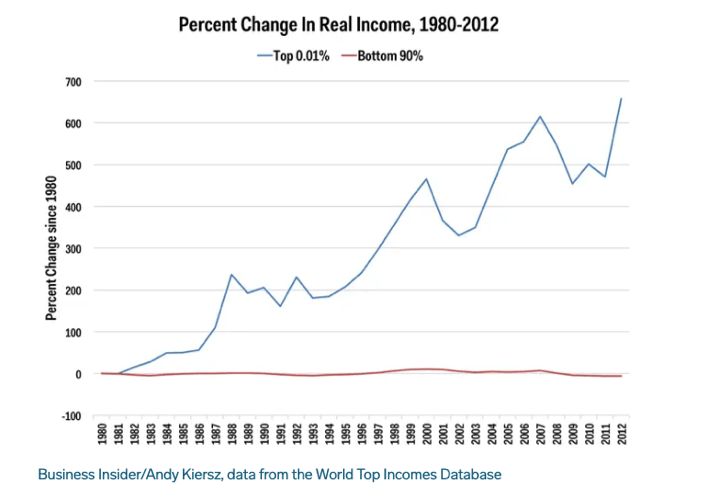
When the stagflation crisis of the 1970s threw classic Keynesian economics into disrepute, their moment of opportunity arrived. By 1985, with free market disciples Ronald Reagan and Margaret Thatcher entrenched in power, they initiated a campaign to systematically transform virtually all aspects of life into an unrestrained marketplace, where everything could be bought and sold to the highest bidder, subject to no moral scruple. They crippled trade unions, tore up social safety nets, reduced tax rates for the wealthy, eliminated regulations, and instituted a massive transfer of wealth from society at large to the uber-elite. Every time a new crisis occurred of their own making, such as the Great Recession of 2008, they took advantage of the mayhem they caused to double down on their power, and extend their reach even further, bringing the ideology of the marketplace into domains, such as education, law enforcement, or wilderness preserves, that had previously been considered sacrosanct.

The Neoliberal conspiracy has succeeded in transferring massive wealth to the uber-elite

With the advent of the Covid-19 pandemic, this conspiracy has found yet another opportunity to squeeze wealth from the bulk of society into the hands of the few. In the United States, since the pandemic began, while 200,000 Americans have died from coronavirus and more than 50 million have lost their jobs, the collective wealth of this country’s billionaires has soared 29% to $3.8 trillion. Jeff Bezos alone could give every Amazon employee $105,000 and still be as wealthy as he was before coronavirus hit.

2. Conspiracy by transnational corporations to turn billions of people into addicts

In the 1920s, two ruthless men laid out a sinister scheme to gain control of the minds of Americans. Their plan? To identify people’s deeply buried needs and use subtle messaging to manipulate them into doing whatever they wanted without realizing it—even at the cost of their health and well-being. One of them, Edward Bernays, was Sigmund Freud’s nephew and used his uncle’s insights into the subconscious to develop his new methods. Their goal was to turn normal working Americans into manic consumers, training them to desire an ever-increasing amount of goods, and thereby converting their life’s energy into profit for American corporations. “We must shift America from a needs to a desires culture,” declared Bernays’ partner, Paul Mazur. “People must be trained to desire, to want new things, even before the old have been entirely consumed. We must shape a new mentality. Man’s desires must overshadow his needs.”

In 1928, Bernays proudly described how his techniques for mental manipulation had already permitted a small elite to control the minds of the American population:

The conscious and intelligent manipulation of the organized habits and opinions of the masses is an important element in democratic society. Those who manipulate this unseen mechanism of society constitute an invisible government that is the true ruling power of this country.
​We are governed, our minds molded, our tastes formed, our ideas suggested, largely by men we have never heard of. . . . In almost every act of our daily lives. . . we are dominated by the relatively small number of persons . . . who pull the wires which control the public mind.

Since then, this conspiracy has succeeded beyond its instigators’ wildest dreams. Corporations have perfected the technique of mind control by tweaking core human instincts that originally evolved to support our ancestors’ flourishing in hunter-gatherer bands—such as the desire for status or fear of exclusion—for their nefarious purposes.

Corporate predators have learned that the most valuable population to ensnare are children. In the sinister words of chief executive Wayne Chilicki, “When it comes to targeting kid consumers, we at General Mills . . . believe in getting them early and having them for life.” Children in the Global South are turned into junk food addicts with the same callous contempt that factory farms turn their animals into chicken nuggets. Half of the children in south Asia are now either undernourished or overweight, conditioned by pervasive advertising to spend what little money they have on the empty calories of junk food.

A new generation of mind controllers are now using sophisticated data mining technologies to inject their power even deeper into our minds. At the ominously named Stanford Persuasive Technology Lab, a modern-day Bernays named B. J. Fogg has taught budding entrepreneurs how to use “hot triggers” such as thumbs-up signs and “Like” statistics to activate short hits of dopamine in our brains that literally get us addicted to our screens. With social media now infiltrating every aspect of many teenagers’ lives, the power of predatory corporate advertising to control their minds for profit has become even more formidable. In 2017, a leaked document revealed Facebook boasting to advertisers how they can identify in real time when teenagers feel “insecure” and “worthless,” and would be most susceptible to a “confidence boost.”

3. Conspiracy to plunder the Global South for the benefit of the Global North

Ever since Portuguese and Spanish explorers set sail in the fifteenth century on a quest for wealth and power, a small population of white Europeans have conspired to use their technological advantage to despoil, plunder, and exploit the rest of the world’s wealth for their own benefit. With the Treaty of Saragossa in 1529, Spain and Portugal carved up the non-European continents between them for conquest and booty. After the Industrial Revolution, the countries of northern Europe took over the plot for global supremacy, devastating the lives of tens of millions of Africans mercilessly chained and shipped as slaves to the colonies.

After the abolition of the slave trade, the brutal exploitation continued through an international system of indentured labor. Having destroyed their livelihood in their native countries, European potentates transported more than 60 million desperate workers from India, China, and the Pacific islands to territories where they were needed, in what was frequently referred to as the “new form of slavery.” This vast global scheme of human trafficking was promoted by colonial magnates such as Cecil Rhodes who declared: “We must find new lands from which we can easily obtain raw materials and at the same time exploit the cheap slave labour that is available from the natives of the colonies. The colonies would also provide a dumping ground for the surplus goods produced in our factories.”

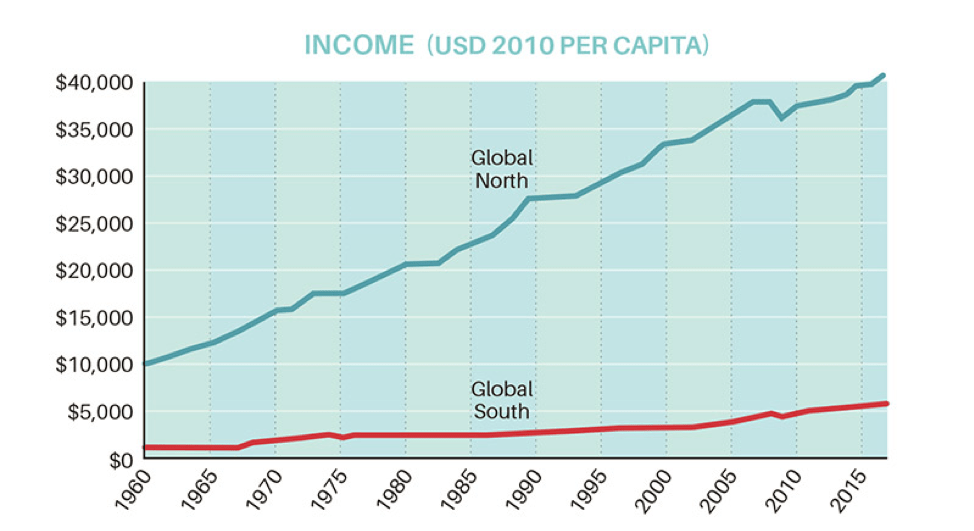
In more recent times, the plot continues in different guises. During the decades after the Second World War, Global South leaders who demanded a fair role in the economic system were systematically deposed in coups arranged by U.S., British, and French militaries. In a vast loan sharking scheme, countries impoverished by colonialism then racked up unsustainable debts forced on them by Global North banks. When they couldn’t pay them back without bankrupting their nations, they were coerced into so-called “structural adjustment programs” which opened their labor markets and natural resources to further plunder by the North’s transnational corporations. The World Bank, IMF, and World Trade Organization are all controlled by a few wealthy nations that set the terms for international trade, with the result that through a combination of illicit financial flows, debt interest payments, and profit repatriation, wealth continues to flow from the South to the North at the rate of about $3 trillion per year.


The income gap between Global North and South has quadrupled since 1960. Data from World Bank.

4. Conspiracy to hide the effects of climate breakdown for corporate profit

For over fifty years, fossil fuel executives have known about the reality of human-induced climate change, yet they spent most of that time deliberately concealing their knowledge and obfuscating public discussion on the topic so they could rake in trillions of dollars in profit. In 1968, the Stanford Research Institute alerted the American Petroleum Institute—the national trade association that represents America’s oil and natural gas industry—to the fact that CO2 emissions were accumulating in the atmosphere, and could reach 400 parts per million by 2000. Their report warned that rising CO2 levels would result in melting ice caps, rising seas, and serious environmental damage worldwide. Exxon scientists studied the issue further, reporting to management in 1977 that there was “overwhelming” consensus that fossil fuels were responsible for CO2 increases. In an internal Exxon memo in 1981, scientists raised the alarm that the company’s 50-year plan “will later produce effects which will indeed be catastrophic (at least for a substantial fraction of the Earth’s population).”

Exxon—and the other fossil fuel companies—knew their actions would lead to climate breakdown, and instead of trying to solve the problem, they lied to the public to hide their misdeeds. Following the example of the tobacco industry, which had already condemned millions to early deaths through cynical deception, they embarked on a concerted strategy to dupe the public by paying fake experts to publish papers; cherry picking selective data to support false conclusions; and sow their own wild conspiracy theories to deflect attention from their crimes.

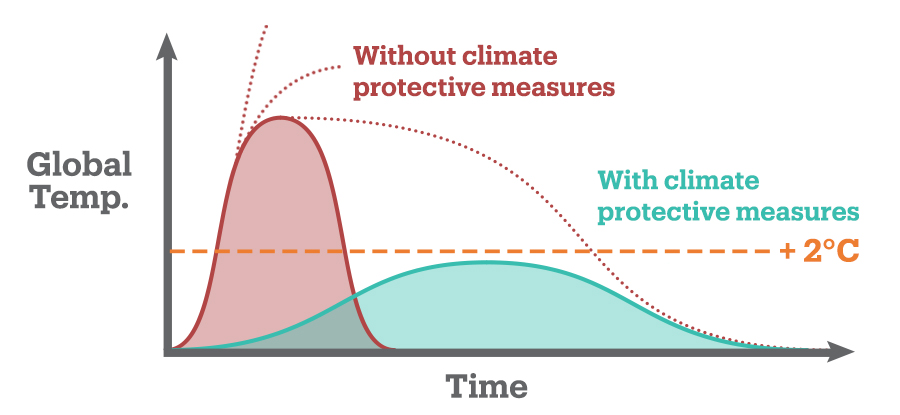
As a result of their immoral plot, the world is now facing a dire climate emergency. If the fossil fuel companies had confronted the issue honestly from the outset, there could have been a managed transition to renewable energy over decades, causing little disruption and saving millions of lives through reduced pollution. Instead, it will now take an immediate global mobilization to avoid a 2° C rise in temperature over preindustrial levels. The world is currently on track for more than a 3° C rise this century, with the high likelihood of stumbling into a tipping point cascade that quickly leads to a three- and four-degree world—one that becomes rapidly unrecognizable, with the Amazon rainforest turning into searing desert; coastal cities inundated by flooding; super-hurricanes tearing the windows out of skyscrapers; persistent massive droughts and famine across the world; and hundreds of millions of desperate climate refugees.

Meanwhile, by putting billions of human lives in jeopardy, the four biggest fossil fuel companies—ExxonMobil, Royal Dutch Shell, Chevron, and BP—have made $2 trillion in profits since they began their campaign of lies in 1990.

5. Conspiracy to grow the global economy indefinitely, while killing most of life on Earth and risking the collapse of civilization.

In a barely noticed footnote to the daily news, the World Wildlife Fund recently released a shocking report revealing a devastating 68% worldwide decline in animal populations in the past fifty years. Even this dismal news hides more gut-wrenching statistics, such as the 84% decline in amphibians, reptiles, and fishes, or the 94% decline in animal populations in South America.

This is just the latest bulletin marking the demise of nature as it succumbs to the relentless growth of human economic activity across the world. Three-quarters of all land has been appropriated for human purposes, either turned into farmland, covered by concrete, or flooded by reservoirs. Three-quarters of rivers and lakes are used for crop or livestock cultivation, with many of the world’s greatest rivers, such as the Ganges, Yangtze, or Nile, no longer reaching the sea. Half of the world’s forests and wetlands have disappeared—the Amazon rainforest alone is vanishing at the rate of an acre every second.

Meanwhile, the world’s Gross Domestic Product is forecast to nearly triple by the middle of this century, by which time it’s estimated that 5 billion people will be facing water shortages, 95% of the Earth’s arable land will be degraded—and there will be more plastic than fish in the ocean. It’s been estimated by leading experts that, by the end of this century, half of the world’s estimated 8 million species will be extinct or at the brink of extinction unless humanity changes its ways. These depredations, combined with climate breakdown, are believed by an increasing number of analysts to spell the likely collapse of modern civilization.

The underlying cause of this headlong rush to catastrophe is our society’s obsession with economic growth as the sole criterion for measuring success. A dangerous myth of “green growth” propagated by techno-optimists argues that through technological innovation, GDP can become “decoupled” from resource use and carbon emissions, permitting limitless growth on a finite planet. This has been shown to be nothing but a fantasy: it hasn’t happened so far, and even the most wildly aggressive assumptions for greater efficiency lead to unsustainable consumption of global resources.

So who, in this case, are the conspirators? If you’re living a normal life in an affluent country, you don’t need to look further than the mirror. The wealthy OECD nations, with only 18% of the global population, account for 74% of global GDP, and the richest 10% of people are responsible for more than half the world’s carbon emissions.

Those of us who continue to benefit from the inequities dealt us by the global system, and aren’t actively engaged in curbing it, are like a few shipwrecked survivors on a gilded lifeboat kicking others desperately scrambling for life into the ocean to protect their own safety and comfort. We may not be actively kicking their knuckles, but by allowing this reckless system of unsustainable growth to continue, we’re implicitly making the same choice.

So, the next time someone tells you to “do your research” on their new conspiracy theory, please point them to the real conspiracies that are threatening life on this beautiful but troubled planet. The good news is that, since they’re real conspiracies, there is something we can do about them. We can vote in politicians that promise to peel back the neoliberal nightmare; advocate for curbs on predatory corporate activities; support the Global South in changing the terms of international trade; declare a Climate Emergency in our community to turn around carbon emissions; and become active in the movement to transform our global society to an Ecological Civilization—one that is based on life-affirming principles rather than accumulating wealth.


Jeremy Lent is author of The Patterning Instinct: A Cultural History of Humanity’s Search for Meaning, which investigates how different cultures have made sense of the universe and how their underlying values have changed the course of history. His upcoming book, The Web of Meaning: Integrating Science and Traditional Wisdom to Find Our Place in the Universe, will be published in Spring 2021 (New Society Publishers: US/Canada | Profile Books: UK/Commonwealth). For more information visit jeremylent.com.

The Coronavirus as a Crucible

I recently participated in a conversation with thought leaders at the Great Transition Initiative on a critical question poised by Paul Raskin:


“The coronavirus outbreak has disrupted our lives, equanimity, and assumptions. . . The pandemic is a rupture in historic time that shakes the continuity of institutions and consciousness. . . How can we seize the moment to steer toward the Great Transition we all hope for and know to be possible?


Here’s my contribution, “The Coronavirus as a Crucible” which explores how progressive leaders might skillfully use the dramatic changes we’re already experiencing to steer society toward the greater transformation that’s needed.

I recommend exploring the full conversation at the Great Transition Initiative website.

THE IMPACT OF CORONAVIRUS will be huge—but it is not yet the crisis that could push our global society into the phase change required for the Great Transition. These two simple facts offer a valuable framework for thinking about how to respond most effectively to the current situation.

To begin, let’s consider the magnitude of COVID-19’s impact. A year or two from now, the virus itself will likely have become a manageable part of our lives—effective treatments will have emerged; a vaccine will be available. But the effect of coronavirus on our global civilization will only just be unfolding. The massive disruptions we’re already seeing in our lives are just the first heralds of a historic transformation in political and societal norms.

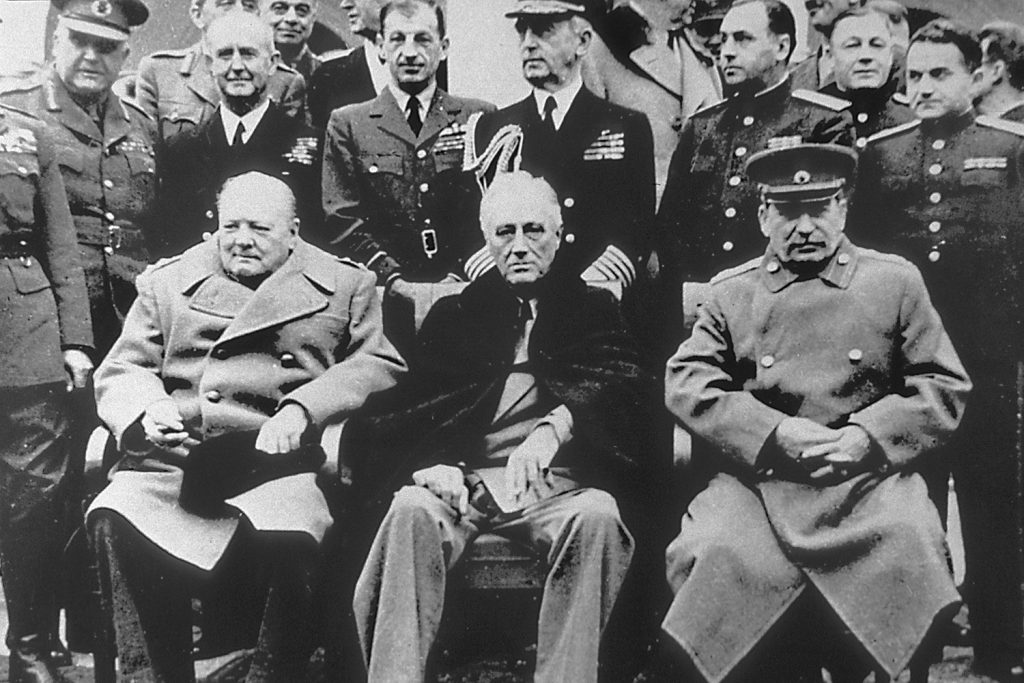
If COVID-19 were spreading across a stable and resilient world, its impact could be abrupt but contained. Leaders would consult together, economies would be disrupted temporarily, people would make do for a while with changed circumstances, and then, after the shock, things would return to normal. That is not, however, the world in which we live. Instead, the pandemic is revealing the structural faults of the system, which have been papered over for decades even as they’ve been growing worse. Gaping economic inequalities, rampant ecological destruction, and pervasive political corruption are all results of unbalanced systems relying on each other to remain precariously poised. Now, as one system destabilizes, expect others to tumble down in tandem in a cascade known by researchers as “synchronous failure.” The last time a disruption of such magnitude occurred was during the period of the Great Depression and World War II, which shaped the geopolitical structure of our current world.

Coronavirus as a Crucible

In just a few months, we have seen political and economic ideas seriously discussed that had previously been dismissed as fanciful or utterly unacceptable: universal basic income, government intervention to house the homeless, and state surveillance on individual activity, to name just a few. This is just the beginning of a process that will expand exponentially in the ensuing months, as the world begins to reel from the aftereffects of the shutdown.

A crisis such as the coronavirus pandemic has a way of massively amplifying and accelerating changes that were already underway: shifts that might have taken decades can occur in weeks. Like a crucible, it has the potential to melt down the structures that currently exist and reshape them, perhaps unrecognizably.

What might the new shape of society look like? There is a serious risk that the new stable state will be closer to a Fortress World, with increased state surveillance, empowered authoritarianism, further breakdowns in democratic norms, mega-corporations even more dominant, and heightened militarism in international relations. In contrast, as many have pointed out, there is also a resurgence in the values that would underlie a transformed world, such as mutual aid, compassionate community, grassroots empowerment, and global collaboration.

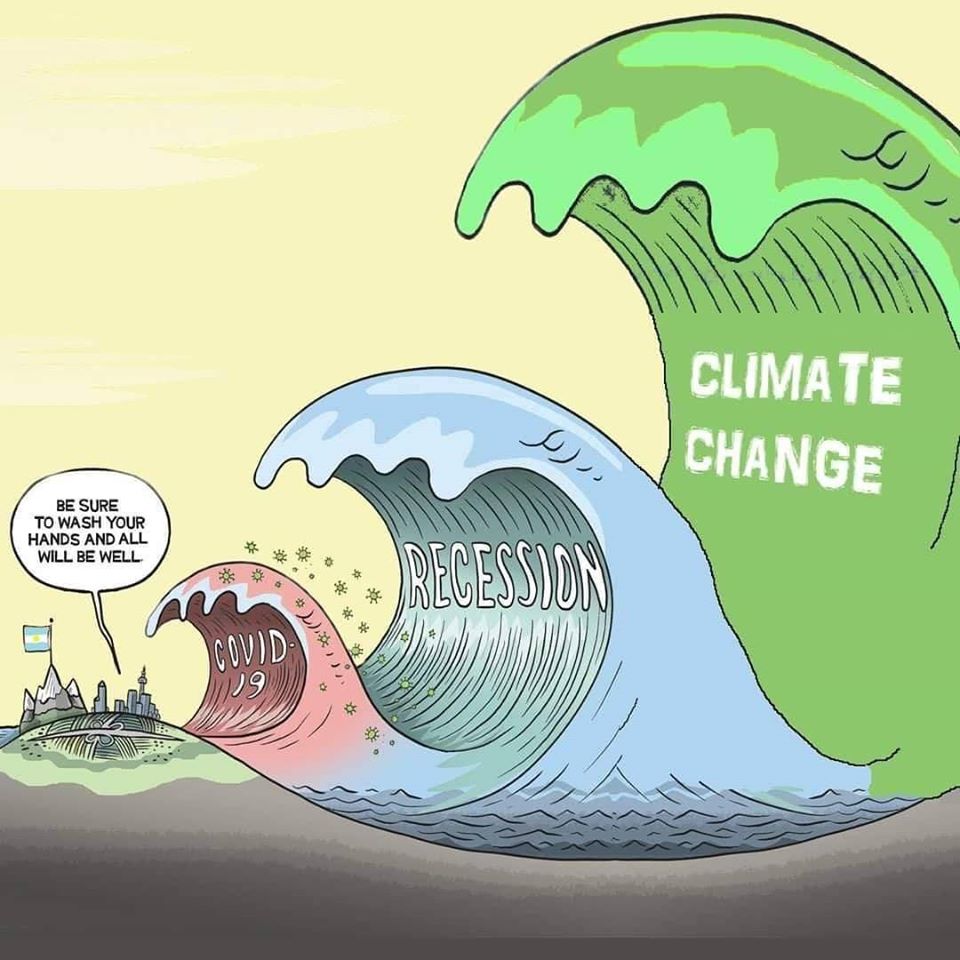
The Next (Tidal) Wave

However, no matter which way the crucible hardens, COVID-19 is not a big enough phenomenon to reshape the flawed foundation of our current worldview that has brought our civilization to its current predicament. Our dominant worldview is based on an underlying theme of separation: people are separate from each other, humans are separate from nature, and nature itself is no more than an economic resource. The value system built on this foundation is the ultimate cause of the world’s gaping inequalities, our roller-coaster global financial system, our failure to respond to climate breakdown, and our unsustainable frenzy of consumption. It provides the implicit basis for ruthless neoliberal policies, the domination of transnational corporations focused solely on shareholder returns, and the worldwide obsession with maintaining unsustainable GDP growth on a finite planet.

As our civilization hurtles toward the precipice through this century, we will encounter ever greater shocks that will make COVID-19 seem like a leisurely rehearsal by contrast. We can expect massive urban flooding, global famines, and overwhelming refugee crises that will shake the foundations of our civilization’s overbuilt edifice. As the interconnected links of our global system unravel, millions of people will reject the values that wrought this devastation, and look for a replacement. The value system they choose will determine whether this century ends in a Fortress World, a civilizational collapse, or a fundamental transition to a life-affirming world based on dignity and community: an ecological civilization.

Coronavirus as a Trimtab

This is the broader context that sheds light on the importance of COVID-19. By itself, this pandemic won’t force the required change in our civilization’s direction, but it can begin to set a course away from the current trajectory of rampant self-destruction. Buckminster Fuller offered the brilliant metaphor of a trimtab, the miniature rudder in front of an ocean liner that helps the main rudder to shift direction almost effortlessly by changing the pressure in front of it. Similarly, we can view the potential for significant policy changes in the wake of coronavirus as a trimtab for the redirection of our global civilization that is the only way to avert catastrophe in the longer term.

This suggests that the most skillful approach to the current situation is to identify those policy initiatives that are already garnering popular support—and can also serve as trimtabs to move our entire civilization toward a new trajectory. In my view, some of the highest potential trimtabs are the idea of a universal basic income, which is now being discussed favorably even in conservative mouthpieces such as the Financial Times; Kate Raworth’s “doughnut economics,” which is being used as a model for Amsterdam’s coronavirus recovery plan; and full-scale implementation of a Green New Deal in the United States.

Others may identify other trimtabs that are just as, or even more, effective. I simply offer this framework as a lens to view how we might skillfully prioritize the progressive forces unleashed by the current pandemic as preparation for the far greater disruptions yet to come.

Coronavirus Spells the End of the Neoliberal Era. What’s Next?

Coronavirus is a political crucible, melting down and reshaping current norms. Will the new era be a “Fortress Earth” or a harbinger of a transformed society based on a new set of values?

Think Bigger

Whatever you might be thinking about the long-term impacts of the coronavirus epidemic, you’re probably not thinking big enough.

Our lives have already been reshaped so dramatically in the past few weeks that it’s difficult to see beyond the next news cycle. We’re bracing for the recession we all know is here, wondering how long the lockdown will last, and praying that our loved ones will all make it through alive.

But, in the same way that Covid-19 is spreading at an exponential rate, we also need to think exponentially about its long-term impact on our culture and society. A year or two from now, the virus itself will likely have become a manageable part of our lives—effective treatments will have emerged; a vaccine will be available. But the impact of coronavirus on our global civilization will only just be unfolding. The massive disruptions we’re already seeing in our lives are just the first heralds of a historic transformation in political and societal norms.

If Covid-19 were spreading across a stable and resilient world, its impact could be abrupt but contained. Leaders would consult together; economies disrupted temporarily; people would make do for a while with changed circumstances—and then, after the shock, look forward to getting back to normal. That’s not, however, the world in which we live. Instead, this coronavirus is revealing the structural faults of a system that have been papered over for decades as they’ve been steadily worsening. Gaping economic inequalities, rampant ecological destruction, and pervasive political corruption are all results of unbalanced systems relying on each other to remain precariously poised. Now, as one system destabilizes, expect others to tumble down in tandem in a cascade known by researchers as “synchronous failure.”

The first signs of this structural destabilization are just beginning to show. Our globalized economy relies on just-in-time inventory for hyper-efficient production. As supply chains are disrupted through factory closures and border closings, shortages in household items, medications, and food will begin surfacing, leading to rounds of panic buying that will only exacerbate the situation. The world economy is entering a downturn so steep it could exceed the severity of the Great Depression. The international political system—already on the ropes with Trump’s “America First” xenophobia and the Brexit fiasco—is likely to unravel further, as the global influence of the United States tanks while Chinese power strengthens. Meanwhile, the Global South, where Covid-19 is just beginning to make itself felt, may face disruption on a scale far greater than the more affluent Global North.

The Overton Window

During normal times, out of all the possible ways to organize society, there is only a limited range of ideas considered acceptable for mainstream political discussion—known as the Overton window. Covid-19 has blown the Overton window wide open. In just a few weeks, we’ve seen political and economic ideas seriously discussed that had previously been dismissed as fanciful or utterly unacceptable: universal basic income, government intervention to house the homeless, and state surveillance on individual activity, to name just a few. But remember—this is just the beginning of a process that will expand exponentially in the ensuing months.

A crisis such as the coronavirus pandemic has a way of massively amplifying and accelerating changes that were already underway: shifts that might have taken decades can occur in weeks. Like a crucible, it has the potential to melt down the structures that currently exist, and reshape them, perhaps unrecognizably. What might the new shape of society look like? What will be center stage in the Overton window by the time it begins narrowing again?

The Example of World War II

We’re entering uncharted territory, but to get a feeling for the scale of transformation we need to consider, it helps to look back to the last time the world underwent an equivalent spasm of change: the Second World War.

The pre-war world was dominated by European colonial powers struggling to maintain their empires. Liberal democracy was on the wane, while fascism and communism were ascendant, battling each other for supremacy. The demise of the League of Nations seemed to have proven the impossibility of multinational global cooperation. Prior to Pearl Harbor, the United States maintained an isolationist policy, and in the early years of the war, many people believed it was just a matter of time before Hitler and the Axis powers invaded Britain and took complete control of Europe.

The Yalta Conference, 1945: Allied leaders reshaped the new global era

Within a few years, the world was barely recognizable. As the British Empire crumbled, geopolitics was dominated by the Cold War which divided the world into two political blocs under the constant threat of nuclear Armageddon. A social democratic Europe formed an economic union that no-one could previously have imagined possible. Meanwhile, the US and its allies established a system of globalized trade, with institutions such as the IMF and the World Bank setting terms for how the “developing world” could participate. The stage was set for the “Great Acceleration”: far and away the greatest and most rapid increase of human activity in history across a vast number of dimensions, including global population, trade, travel, production, and consumption. 

If the changes we’re about to undergo are on a similar scale to these, how might a future historian summarize the “pre-coronavirus” world that is about to disappear?

The Neoliberal Era            

There’s a good chance they will call this the Neoliberal Era. Until the 1970s, the post-war world was characterized in the West by an uneasy balance between government and private enterprise. However, following the “oil shock” and stagflation of that period—which at the time represented the world’s biggest post-war disruption—a new ideology of free-market neoliberalism took center stage in the Overton window (the phrase itself was named by a neoliberal proponent).

The value system of neoliberalism, which has since become entrenched in global mainstream discourse, holds that humans are individualistic, selfish, calculating materialists, and because of this, unrestrained free-market capitalism provides the best framework for every kind of human endeavor. Through their control of government, finance, business, and media, neoliberal adherents have succeeded in transforming the world into a globalized market-based system, loosening regulatory controls, weakening social safety nets, reducing taxes, and virtually demolishing the power of organized labor.

The triumph of neoliberalism has led to the greatest inequality in history, where (based on the most recent statistics) the world’s twenty-six richest people own as much wealth as half the entire world’s population. It has allowed the largest transnational corporations to establish a stranglehold over other forms of organization, with the result that, of the world’s hundred largest economies, sixty-nine are corporations. The relentless pursuit of profit and economic growth above all else has propelled human civilization onto a terrifying trajectory. The uncontrolled climate crisis is the most obvious danger: The world’s current policies have us on track for more than 3° increase by the end of this century, and climate scientists publish dire warnings that amplifying feedbacks could make things far worse than even these projections, and thus place at risk the very continuation of our civilization.

But even if the climate crisis were somehow brought under control, a continuation of untrammeled economic growth in future decades will bring us face-to-face with a slew of further existential threats. Currently, our civilization is running at 40% above its sustainable capacity. We’re rapidly depleting the earth’s forestsanimalsinsectsfishfreshwater, even the topsoil we require to grow our crops. We’ve already transgressed three of the nine planetary boundaries that define humanity’s safe operating space, and yet global GDP is expected to more than double by mid-century, with potentially irreversible and devastating consequences.

In 2017 over fifteen thousand scientists from 184 countries issued an ominous warning to humanity that time is running out: “Soon it will be too late,” they wrote, “to shift course away from our failing trajectory.” They are echoed by the government-approved declaration of the UN-sponsored IPCC, that we need “rapid, far-reaching and unprecedented changes in all aspects of society” to avoid disaster.

In the clamor for economic growth, however, these warnings have so far gone unheeded. Will the impact of coronavirus change anything?

Fortress Earth

There’s a serious risk that, rather than shifting course from our failing trajectory, the post-Covid-19 world will be one where the same forces currently driving our race to the precipice further entrench their power and floor the accelerator directly toward global catastrophe. China has relaxed its environmental laws to boost production as it tries to recover from its initial coronavirus outbreak, and the US (anachronistically named) Environmental Protection Agency took immediate advantage of the crisis to suspend enforcement of its laws, allowing companies to pollute as much as they want as long as they can show some relation to the pandemic.

On a greater scale, power-hungry leaders around the world are taking immediate advantage of the crisis to clamp down on individual liberties and move their countries swiftly toward authoritarianism. Hungary’s strongman leader, Viktor Orban, officially killed off democracy in his country on Monday, passing a bill that allows him to rule by decree, with five-year prison sentences for those he determines are spreading “false” information. Israel’s Prime Minister Netanyahu shut down his country’s courts in time to avoid his own trial for corruption. In the United States, the Department of Justice has already filed a request to allow the suspension of courtroom proceedings in emergencies, and there are many who fear that Trump will take advantage of the turmoil to install martial law and try to compromise November’s election.

Even in those countries that avoid an authoritarian takeover, the increase in high-tech surveillance taking place around the world is rapidly undermining previously sacrosanct privacy rights. Israel has passed an emergency decree to follow the lead of China, Taiwan, and South Korea in using smartphone location readings to trace contacts of individuals who tested positive for coronavirus. European mobile operators are sharing user data (so far anonymized) with government agencies. As Yuval Harari has pointed out, in the post-Covid world, these short-term emergency measures may “become a fixture of life.”

If these, and other emerging trends, continue unchecked, we could head rapidly to a grim scenario of what might be called “Fortress Earth,” with entrenched power blocs eliminating many of the freedoms and rights that have formed the bedrock of the post-war world. We could be seeing all-powerful states overseeing economies dominated even more thoroughly by the few corporate giants (think Amazon, Facebook) that can monetize the crisis for further shareholder gain.

The chasm between the haves and have-nots may become even more egregious, especially if treatments for the virus become available but are priced out of reach for some people. Countries in the Global South, already facing the prospect of disaster from climate breakdown, may face collapse if coronavirus rampages through their populations while a global depression starves them of funds to maintain even minimal infrastructures. Borders may become militarized zones, shutting off the free flow of passage. Mistrust and fear, which has already shown its ugly face in panicked evictions of doctors in India and record gun-buying in the US, could become endemic.

Society Transformed

But it doesn’t have to turn out that way. Back in the early days of World War II, things looked even darker, but underlying dynamics emerged that fundamentally altered the trajectory of history. Frequently, it was the very bleakness of the disasters that catalyzed positive forces to emerge in reaction and predominate. The Japanese attack on Pearl Harbor—the day “which will live in infamy”—was the moment when the power balance of World War II shifted. The collective anguish in response to the global war’s devastation led to the founding of the United Nations. The grotesque atrocity of Hitler’s holocaust led to the international recognition of the crime of genocide, and the UN’s Universal Declaration of Human Rights.

Could it be that the crucible of coronavirus will lead to a meltdown of neoliberal norms that ultimately reshapes the dominant structures of our global civilization? Could a mass collective reaction to the excesses of authoritarian overreach lead to a renaissance of humanitarian values? We’re already seeing signs of this. While the Overton window is allowing surveillance and authoritarian practices to enter from one side, it’s also opening up to new political realities and possibilities on the other side. Let’s take a look at some of these.

A fairer society. The specter of massive layoffs and unemployment has already led to levels of state intervention to protect citizens and businesses that were previously unthinkable. Denmark plans to pay 75% of the salaries of employees in private companies hit by the effects of the epidemic, to keep them and their businesses solvent. The UK has announced a similar plan to cover 80% of salaries. California is leasing hotels to shelter homeless people who would otherwise remain on the streets, and has authorized local governments to halt evictions for renters and homeowners. New York state is releasing low-risk prisoners from its jails. Spain is nationalizing its private hospitals. The Green New Deal, which was already endorsed by the leading Democratic presidential candidates, is now being discussed as the mainstay of a program of economic recovery. The idea of universal basic income for every American, boldly raised by long-shot Democratic candidate Andrew Yang, has now become a talking point even for Republican politicians.

Ecological stabilization. Coronavirus has already been more effective in slowing down climate breakdown and ecological collapse than all the world’s policy initiatives combined. In February, Chinese CO2 emissions were down by over 25%. One scientist calculated that twenty times as many Chinese lives have been saved by reduced air pollution than lost directly to coronavirus. Over the next year, we’re likely to see a reduction in greenhouse gas emissions greater than even the most optimistic modelers’ forecasts, as a result of the decline in economic activity. As French philosopher Bruno Latour tweeted: “Next time, when ecologists are ridiculed because ‘the economy cannot be slowed down’, they should remember that it can grind to a halt in a matter of weeks worldwide when it is urgent enough.”

Of course, nobody would propose that economic activity should be disrupted in this catastrophic way in response to the climate crisis. However, the emergency response initiated so rapidly by governments across the world has shown what is truly possible when people face what they recognize as a crisis. As a result of climate activism, 1,500 municipalities worldwide, representing over 10% of the global population, have officially declared a climate emergency. The Covid-19 response can now be held out as an icon of what is really possible when people’s lives are at stake. In the case of the climate, the stakes are even greater—the future survival of our civilization. We now know the world can respond as needed, once political will is engaged and societies enter emergency mode

The world needs to respond to the climate emergency with a similar urgency to the Covid-19 response. Source: David J. Hayes, NYU Energy & Environmental Impact Center

The rise of “glocalization.” One of the defining characteristics of the Neoliberal Era has been a corrosive globalization based on free market norms. Transnational corporations have dictated terms to countries in choosing where to locate their operations, leading nations to compete against each other to reduce worker protections in a “race to the bottom.” The use of cheap fossil fuels has caused wasteful misuse of resources as products are flown around the world to meet consumer demand stoked by manipulative advertising. This globalization of markets has been a major cause of the Neoliberal Era’s massive increase in consumption that threatens civilization’s future. Meanwhile, masses of people disaffected by rising inequity have been persuaded by right-wing populists to turn their frustration toward outgroups such as immigrants or ethnic minorities.

The effects of Covid-19 could lead to an inversion of these neoliberal norms. As supply lines break down, communities will look to local and regional producers for their daily needs. When a consumer appliance breaks, people will try to get it repaired rather than buy a new one. Workers, newly unemployed, may turn increasingly to local jobs in smaller companies that serve their community directly.

At the same time, people will increasingly get used to connecting with others through video meetings over the internet, where someone on the other side of the world feels as close as someone across town. This could be a defining characteristic of the new era. Even while production goes local, we may see a dramatic increase in the globalization of new ideas and ways of thinking—a phenomenon known as “glocalization.” Already, scientists are collaborating around the world in an unprecedented collective effort to find a vaccine; and a globally crowdsourced library is offering a “Coronavirus Tech Handbook” to collect and distribute the best ideas for responding to the pandemic.

Compassionate community. Rebecca Solnit’s 2009 book, A Paradise Built in Hell, documents how, contrary to popular belief, disasters frequently bring out the best in people, as they reach out and help those in need around them. In the wake of Covid-19, the whole world is reeling from a disaster that affects us all. The compassionate response Solnit observed in disaster zones has now spread across the planet with a speed matching the virus itself. Mutual aid groups are forming in communities everywhere to help those in need. The website Karunavirus (Karuna is a Sanskrit word for compassion) documents a myriad of everyday acts of heroism, such as the thirty thousand Canadians who have started “caremongering,” and the mom-and-pop restaurants in Detroit forced to close and now cooking meals for the homeless.

In the face of disaster, many people are rediscovering that they are far stronger as a community than as isolated individuals. The phrase “social distancing” is helpfully being recast as “physical distancing” since Covid-19 is bringing people closer together in solidarity than ever before.

Revolution in Values

This rediscovery of the value of community has the potential to be the most important factor of all in shaping the trajectory of the next era. New ideas and political possibilities are critically important, but ultimately an era is defined by its underlying values, on which everything else is built.

The Neoliberal Era was constructed on a myth of the selfish individual as the foundational for values. As Margaret Thatcher famously declared, “There’s no such thing as society. There are individual men and women and there are families.” This belief in the selfish individual has not just been destructive of community—it’s plain wrong. In fact, from an evolutionary perspective, a defining characteristic of humanity is our set of prosocial impulses—fairness, altruism, and compassion—that cause us to identify with something larger than our own individual needs. The compassionate responses that have arisen in the wake of the pandemic are heartwarming but not surprising—they are the expected, natural human response to others in need.

Once the crucible of coronavirus begins to cool, and a new sociopolitical order emerges, the larger emergency of climate breakdown and ecological collapse will still be looming over us. The Neoliberal Era has set civilization’s course directly toward a precipice. If we are truly to “shift course away from our failing trajectory,” the new era must be defined, at its deepest level, not merely by the political or economic choices being made, but by a revolution in values. It must be an era where the core human values of fairness, mutual aid, and compassion are paramount—extending beyond the local neighborhood to state and national government, to the global community of humans, and ultimately to the community of all life. If we can change the basis of our global civilization from one that is wealth-affirming to one that is life-affirming, then we have a chance to create a flourishing future for humanity and the living Earth.

To this extent, the Covid-19 disaster represents an opportunity for the human race—one in which each one of us has a meaningful part to play. We are all inside the crucible right now, and the choices we make over the weeks and months to come will, collectively, determine the shape and defining characteristics of the next era. However big we’re thinking about the future effects of this pandemic, we can think bigger. As has been said in other settings, but never more to the point: “A crisis is a terrible thing to waste.”


Jeremy Lent is author of The Patterning Instinct: A Cultural History of Humanity’s Search for Meaning, which investigates how different cultures have made sense of the universe and how their underlying values have changed the course of history. His upcoming book, The Web of Meaning: Integrating Science and Traditional Wisdom to Find Our Place in the Universe, will be published in Spring 2021 (New Society Press: North America | Profile Books: UK & Commonwealth). For more information visit jeremylent.com.


Do you want to think even bigger?

Watch Jeremy Lent’s talk on “Living into an Ecological Civilization”

Presented at Civana House, San Francisco, October 3, 2019

Embracing Interconnectedness

I recently participated in a conversation with thought leaders at the Great Transition Initiative on how to shift our society’s foundational ethical framework for the deep transformation of civilization that is needed.

Here’s my contribution, “Embracing Interconnectedness,” which features ideas that will be part of my upcoming book, The Web of Meaning: Integrating Science and Traditional Wisdom to Find Our Place in the Universe (to be published in Spring 2021).

I recommend exploring the full conversation at the Great Transition Initiative website.


I BELIEVE IT IS of the utmost importance to establish the right framework of values for the deep transformation of civilization that is needed. As I have laid out in The Patterning Instinct, different cultures have constructed vastly different systems of values, and those values have shaped history. Similarly, the values we choose today as a society will shape our future. The stakes for getting it right could hardly be higher.[1]

In recent decades, neoliberalism has established a dominant pseudo-ethical regime based on a flawed notion of untrammeled, market-based individual freedom. Our overriding task is to substitute this with an ethic of shared responsibility and interdependence. We need a solid, rigorous foundation for this ethic. Where do we find it?

Too much of the conversation on ethics focuses on binaries—materialism vs. spirituality, reason vs. emotions. But binaries simply encourage different camps to put up barricades against each other. We must move beyond binaries to a truly integrated ethical framework—one that incorporates the rational and intuitive, the scientific and the spiritual.

Fortunately, in recent decades, the combination of complexity science, evolutionary biology, cognitive science, and systems thinking has given us a platform for the kind of integration we need. Recognizing an evolutionary basis for values does not mean falling prey to the reductionist determinism of outmoded theorists such as Richard Dawkins, whose “selfish gene” myth has been superseded by modern evolutionary biology. [2]

The major evolutionary transitions of life on Earth have, in fact, been characterized by increases in cooperation, the most recent of which was the emergence of hominids. Facing perilous savannah conditions, our ancestors discovered that, through collaboration, they could protect and feed themselves far more effectively. They evolved moral emotions, such as a sense of fairness, cooperation, and altruism, which enabled them—in what has been called a “reverse dominance hierarchy”—to collaboratively restrain the occasional dangerously aggressive male driven by the atavistic impulse for domination that we see in other primates.[3]

These moral emotions formed the basis of the morality that characterizes our species. Sophisticated tests have shown that, faced with a choice, our initial impulse is to cooperate, and only after time to reflect do selfish behaviors emerge. In various experiments, prelinguistic infants show a rudimentary sense of fairness, justice, empathy, compassion, and generosity, along with a clear ability to distinguish between kind and cruel actions. Morality is intrinsic to the human condition.[4]

So why do we live in a world filled with endless examples of outrageous immorality, where dangerous aggressive males still wield power? With the rise of agriculture and sedentism, the power balance shifted to those who succeeded in establishing hierarchical dominance, leading eventually to the rise of patriarchal societies that rewarded machismo and violence—what Riane Eisler has termed “domination systems.”[5]

The world history of the past millennia mostly chronicles conflicts between different domination systems, one of which—European civilization—eventually became globally dominant in the past few centuries, forcing its unique dualistic cosmology on those it conquered. This is the worldview that most people now take for granted—one based on separation and domination, seeing humans as selfish, rational competitors, defined by their individuality, utterly separate from a desacralized nonhuman nature that has been relegated to a mere mechanistic resource without intrinsic value.

This worldview is a far cry from the shared ethical basis of cross-cultural traditions throughout history, and has been comprehensively invalidated by modern scientific findings. Instead, systems science confirms the insights shared by wisdom teachings across the ages: that we are all intrinsically interconnected. The deep interpenetration of all aspects of reality—what Thich Nhat Hanh calls “interbeing”—must be at the heart of an ethical framework for political and cultural transformation.

Our expression of morality is, to a very large extent, a function of our identity. If you see yourself as an isolated individual, your values will accordingly lead you to the pursuit of your own happiness at the expense of others. If you identify with your community, your values will emphasize the welfare of the group. When you recognize yourself as part of nature, you will automatically feel drawn to nurture and protect the natural world.

Over the past several centuries, even as European imperialism ravaged the rest of the world, there was also a gradual expansion of identity, from the parochial to a broader vision of shared humanity, which has led to what Martin Luther King famously referred to as the “moral arc” bending toward justice. This has inspired concepts such as inalienable human rights and led to ever-widening attempts to legislate moral justice into national and international codes of conduct. The Earth Charter stands as an exemplary model of this kind of expansive moral vision.

However, in our current predicament, facing impending ecological catastrophe and the potential of civilizational collapse, we must ask whether this moral expansion is a case of too little, too late. What can be done to catalyze it and redirect our terrifying trajectory? Is it possible to develop a cross-cultural global moral vision for humanity that extends to all life on Earth, and could inspire a comprehensive transition toward economic justice and ecological regeneration?

While those of us enculturated in the West have had to rediscover our interconnectedness, traditional cultures have maintained the deeply embedded principles that characterized core human morality from earliest times. Comanche social activist LaDonna Harris has identified four central values known as the four R’s that are shared by indigenous peoples around the world, which together affirm the interconnectedness of all aspects of creation: Relationship, Responsibility, Reciprocity, and Redistribution. They each pertain to different types of obligation that inform a person’s life. Relationship is a kinship obligation, recognizing value not just in family but in “all our relations” including animals, plants, and the living Earth. Responsibility is the community obligation, identifying the imperative to nurture and care for those relations. Reciprocity is a cyclical obligation to balance what is given and taken; and Redistribution is the obligation to share what one possesses—not just material wealth, but one’s skills, time, and energy.[6]

Other sources of wisdom, such as Taoism, Buddhism, or Confucianism, each offer unique teachings into the ethical implications of the fundamental unity of all life. “Everything from…husband, wife, and friends, to mountains, rivers…birds, beasts, and plants, all should be truly loved in order that the unity may be reached,” declared Neo-Confucian sage Wang Yangming.

Our crucial task is to incorporate these principles of traditional wisdom into an integrated system of values that can redirect humanity away from catastrophe, and toward a flourishing future. One where our shared identity expands beyond parochial boundaries to include, not just all humanity, but all sentient beings, and the vibrancy of the entire living Earth. Ultimately, it is our values that guide our actions—and will shape our future.

Click to read the entire conversation

[1] Jeremy Lent, The Patterning Instinct: A Cultural History of Humanity’s Search for Meaning (Amherst, NY: Prometheus, 2017).

[2] “New trends in evolutionary biology: biological, philosophical and social science perspectives,” Royal Society | Interface Focus Theme Issue, 7, 5, October 6 (2017).
[3] Christopher Boehm, Hierarchy in the Forest: The Evolution of Egalitarian Behavior (Cambridge, MA: Harvard University Press, 1999).
[4] Paul Bloom, Just Babies: The Origins of Good and Evil (New York: Crown Publishing Group, 2013).
[5] Riane Eisler and Douglas P. Fry, Nurturing Our Humanity: How Domination and Partnership Shape Our Brains, Lives, and Future (New York: Oxford University Press, 2019).
[6] La Donna Harris and Jacqueline Wasilewski, “Indigeneity, an Alternative Worldview: Four R’s (Relationship, Responsibility, Reciprocity, Redistribution) Vs. Two P’s (Power and Profit). Sharing the Journey Towards Conscious Evolution,” Systems Research and Behavioral Science 21 (2004): 489–503.